Introduction
U.S. emergency departments treated 12,154,417 consumer product-related injuries in 2023 alone, according to CPSC's National Electronic Injury Surveillance System. That figure doesn't isolate injuries caused by deficient documentation — but courts have been making that connection for decades.
When a product recall is issued, "New Instructions" is one of the CPSC's recognized corrective-action remedies. That detail tells you something: inadequate documentation isn't a design afterthought. It's a compliance and liability exposure with consequences that outlast the recall itself — lost market access, litigation, and long-term brand damage.
For manufacturers in consumer goods, cosmetics, hardware, and food, ANSI Z535.6-2023 governs how safety information must be structured in product manuals, instruction sheets, and other accompanying materials. This article covers what the standard requires, how its four message types work in practice, and where manufacturers most commonly go wrong.
Key Takeaways
- ANSI Z535.6-2023 governs safety messaging in product manuals, instruction sheets, and collateral materials — not product labels or signs
- The standard defines four message types for placing safety content within documents: supplemental directives, grouped, section, and embedded messages
- Four signal words — DANGER, WARNING, CAUTION, NOTICE — form a strict severity hierarchy with matching color requirements
- Courts treat the standard as the industry benchmark for product liability and duty-to-warn claims, despite its voluntary status
- The 2023 revision expanded the definition of "risk" to mean the combination of the probability and severity of harm
What Is ANSI Z535.6-2023 and Why It Matters for Manufacturers
ANSI Z535.6-2023 — formally titled Product Safety Information in Product Manuals, Instructions, and Other Collateral Materials — is a U.S. voluntary consensus standard that specifies how safety messages must be designed and located in printed documentation that accompanies a product. Owner manuals, assembly guides, user guides, product inserts, installation sheets: all of it falls within Z535.6's scope.
The standard exists because its companion standard, ANSI Z535.4 (which covers product safety signs and labels affixed to a product or packaging), wasn't built for text-heavy documents with multiple hazards at varying depth. Z535.6 fills that gap.
Voluntary Standard, Real Legal Consequences
Technically, no federal law mandates compliance with ANSI Z535.6. In practice, that distinction matters less than many manufacturers assume.
As Holland & Knight noted in legal commentary on Z535.6, courts have recognized ANSI standards as a benchmark — a minimum reference point — for evaluating whether a manufacturer met its duty to warn. Non-compliance doesn't automatically create liability, but it hands opposing counsel a credible argument that your documentation fell short of the industry standard.
In Johnson v. Ridge Tool Manufacturing Company (N.D. Ill., 2025), expert testimony alleged the defendant's product manual violated ANSI Z535 standards as part of a failure-to-warn claim. Manual content — not just product labels — ends up in the discovery record when failure-to-warn claims go to trial.
What Changed in 2023
The 2023 revision made targeted updates rather than structural overhauls:
- Expanded definition of "risk" — now defined as the combination of the probability of occurrence of harm and the severity of that harm
- Minor clarifications throughout the standard for more consistent application
- A revised German translation for the signal word "Notice" (relevant for manufacturers distributing bilingual or multilingual documentation)
For manufacturers producing instruction sheets and inserts for hardware, pharma, or CPG products, the updated "risk" definition directly affects how you categorize and sequence hazard warnings throughout a document — a detail that matters when a plaintiff's expert starts comparing your manual against the standard line by line.
The Four Types of Safety Messages Under ANSI Z535.6
ANSI Z535.6 organizes hazard communication into four distinct message types. Not every document needs all four, but each type serves a specific function, occupies a specific location, and carries its own formatting requirements.
Supplemental Directives
Supplemental directives are messages about other safety messages. They don't describe a specific hazard; they direct readers to safety information located elsewhere in the document. A familiar example: "Read all instructions before use to avoid injury."
These messages typically appear at the front of a document, before procedural content. Signal words are not required unless the directive references a specific hazardous condition.
Grouped Safety Messages
Grouped safety messages consolidate all relevant hazard information into a single section — often near the beginning of a manual, before any procedural steps. The group as a whole must identify hazards, explain consequences, and advise on avoidance.
A few structural notes:
- Individual messages within a group don't need to repeat all three elements if a preceding supplemental directive already covers shared consequences
- Complex products benefit from numbered lists or subheadings within the grouped section
- Placement before procedural content is standard practice
Section and Embedded Safety Messages
These two types operate inside the document body, closer to where users actually encounter hazards.
Section safety messages apply to an entire section or procedure group. Placed at the opening of that section, they warn users before they begin a multi-step process with consistent risk throughout.
Embedded safety messages apply to a specific step, sentence, or procedure within a section. They carry the highest risk of being overlooked when they aren't visually differentiated from surrounding instructional text.
If a hazard appears mid-procedure, an embedded message at that exact point is often necessary — even when a grouped safety section at the front of the document already references the same risk. Users rarely flip back to the front matter mid-task. A front-of-manual grouped section does not substitute for an embedded message when the hazard is tied to a specific action.
To keep the distinction clear:
- Section messages → warn before a multi-step process begins
- Embedded messages → warn at the exact step where the hazard occurs
Signal Words, Safety Colors, and the Safety Alert Symbol
Signal word selection is not subjective. The standard defines a strict hierarchy based on hazard severity, and choosing the wrong word — in either direction — creates problems.
The Four Signal Words
| Signal Word | Hazard Severity |
|---|---|
| DANGER | Will result in death or serious injury |
| WARNING | Could result in death or serious injury |
| CAUTION | Could result in minor or moderate injury |
| NOTICE | Non-injury information: property damage or procedural guidance |
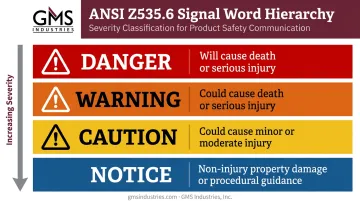
Signal word selection must be tied to a documented risk assessment, not editorial judgment. Research published in Ergonomics (Wogalter and Silver, 1995) found that signal words carry different perceived hazard strengths across audiences — including children, older adults, and non-native English speakers — reinforcing why the correct word choice matters beyond internal consistency.
Color Requirements
Each signal word pairs with a defined color for the signal word panel:
- DANGER — red background, white text
- WARNING — orange background, black text
- CAUTION — yellow background, black text
- NOTICE — blue background, white text
Black-and-white formatting is permissible when color printing isn't available, but color is strongly preferred. User perception of hazard severity is affected by color-word combinations — meaning a CAUTION message printed without its yellow panel may not register at the intended severity level.
The Safety Alert Symbol
The safety alert symbol — an equilateral triangle containing an exclamation mark — appears alongside signal words for all injury-related messages: DANGER, WARNING, and CAUTION. It is not used with NOTICE, which addresses non-personal-injury information.
Since the 2011 edition, the symbol may also appear mid-line within running text — useful for flagging specific hazards inside paragraphs without requiring a full signal word panel block.
Three-Part Message Structure
Every safety message body must include three elements:
- Identify the hazard — what is the specific danger?
- State the consequence — what happens if the hazard is not avoided?
- Advise avoidance — what should the user do (or not do)?
All three are required for legal adequacy and user comprehension. A message that identifies a hazard but omits the consequence, or states a consequence without advising on avoidance, is incomplete under the standard.
Common Mistakes to Avoid When Applying ANSI Z535.6
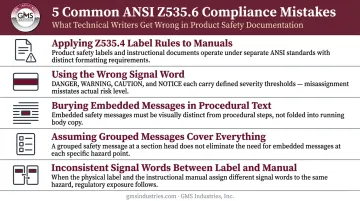
Applying Z535.4 Label Rules to Collateral Materials
Many manufacturers assume their product label standard translates directly to manuals and instruction sheets. It doesn't. Z535.4 governs signs and labels affixed to products or packaging — formats with limited space and single-point hazard communication. Z535.6 was created specifically because those rules don't scale to text-based documents with multiple hazards and procedural depth.
Using the Wrong Signal Word
Calibrating signal words incorrectly creates two distinct problems:
- Under-rating (CAUTION for a potentially fatal hazard) reduces perceived severity and increases liability exposure
- Over-rating (DANGER for a minor risk) desensitizes readers and may cause all warnings to be ignored
Signal word selection requires a formal risk assessment — not a writer's judgment call.
Burying Embedded Messages in Procedural Text
An embedded safety message that looks identical to surrounding instructional text will be skipped. Visual distinction — through signal word panels, borders, white space, or font weight — is required even when full-color printing isn't available.
Proximity to the relevant procedure is the primary value of an embedded message. That value disappears if readers can't distinguish the warning from the surrounding instructions at a glance.
Assuming Grouped Messages Cover Everything
A grouped safety section at the front of a manual does not eliminate the need for section or embedded messages when a hazard applies to a specific step. Users who open a manual to a particular procedure — without reading the front matter — won't encounter those front-of-document warnings. The standard allows flexibility in how message types are combined, but it doesn't permit omission where hazard proximity demands it.
Inconsistency Between Collateral Materials and Product Labels
ANSI Z535.6 is designed to work alongside Z535.4. When a product carries a WARNING label, the corresponding manual should address the same hazard with appropriate depth. Two specific inconsistencies create the most exposure:
- Mismatched signal words — a WARNING on the label paired with a CAUTION in the manual signals different severity levels for the same hazard
- Mismatched hazard descriptions — different language for the same risk causes users to question which source is authoritative
Both weaken user comprehension and strengthen product liability arguments.
Conclusion
ANSI Z535.6-2023 compliance is documented evidence that a manufacturer took a systematic approach to hazard communication — the baseline courts, regulators, and insurers use when evaluating duty-to-warn obligations.
For manufacturers in consumer goods, hardware, cosmetics, and food, the practical starting point is straightforward: pull your existing instruction sheets, product inserts, and user manuals, and review them against the four message types, signal word hierarchy, and three-part message structure the standard requires.
GMS Industries produces custom printed instruction sheets and product documentation for manufacturers across hardware, consumer goods, cosmetics, and beyond — including bilingual and multilingual formats for brands like Kwikset and Dermalogica. Our in-house prepress team and Didde Apollo offset web presses handle high-volume instruction sheet runs with full custom design support. If your existing collateral needs a structural overhaul to meet ANSI Z535.6 formatting requirements, contact us at gmsindustries.com.
Frequently Asked Questions
What is ANSI Z535.6?
ANSI Z535.6 is a U.S. voluntary consensus standard governing how product safety information — signal words, safety alert symbols, and message panel formatting — must appear in collateral materials like owner manuals, instruction sheets, and user guides. It does not apply to safety signs or labels affixed to a product.
What should be included in a safety manual?
A safety manual should incorporate all four ANSI Z535.6 message types — supplemental directives, grouped messages, section messages, and embedded messages — as applicable. Each individual message must identify the hazard, state the consequence of not avoiding it, and explain how to avoid it.
What are the signal words for ANSI Z535?
The four signal words are DANGER (will cause death or serious injury), WARNING (could cause death or serious injury), CAUTION (could cause minor or moderate injury), and NOTICE (non-injury property damage or procedural information). Each signal word corresponds to a specific severity level — choose based on what the hazard actually does, not on how serious you want it to sound.
Is ANSI Z535.6 mandatory?
ANSI Z535.6 is a voluntary standard, but U.S. courts treat it as the industry benchmark for duty-to-warn obligations. Failure to follow it can be introduced as evidence of poor hazard communication in product liability cases.
What is the difference between ANSI Z535.4 and ANSI Z535.6?
ANSI Z535.4 covers product safety signs and labels affixed to a product or its packaging. ANSI Z535.6 governs safety information in collateral materials — manuals, instruction sheets, inserts, and guides. The two standards are complementary and should be applied together for complete hazard communication coverage.
What are collateral materials under ANSI Z535.6?
Collateral materials are printed documents that ship with a product — owner manuals, assembly instructions, user guides, safety manuals, packaging inserts, and printable PDFs. Audio/video content and non-printable digital media fall outside the standard's scope.