Introduction
A label that looks flawless coming off the press can peel, smear, or fade the moment it hits a freezer case, a refrigerated warehouse shelf, or a product shipped through humid summer heat.
For packaging decision-makers, that gap between production and real-world performance is where material choice becomes a genuine operational problem.
The wrong label substrate affects more than aesthetics. It creates compliance risk — FDA regulations require label statements to remain prominent and conspicuous throughout the product's life — and it drives reprinting costs that quickly erode any savings from choosing a cheaper material upfront.
This guide covers the core differences between synthetic and paper labels, including which environments each handles well, where each one fails, and what to look for when choosing between them.
Key Takeaways
- Synthetic labels (PP, PE, PET) resist moisture, chemicals, and temperature swings, making them essential for frozen food, industrial, and pharma applications
- Paper labels cost less upfront and offer tactile finishes that communicate craft or premium positioning
- Specifying the wrong label material leads to adhesion failures, peeling, and costly rework — always match substrate to end environment
- Sustainability isn't a simple paper-wins equation; recyclability depends on the full label and container system
- The right choice is determined by where your product lives after it leaves production
Synthetic Labels vs Paper Labels: Quick Comparison
Both materials support flexographic, digital, and offset printing, and both can look indistinguishable once laminated. The table below shows where they diverge when conditions get demanding.
| Factor | Synthetic Labels | Paper Labels |
|---|---|---|
| Material | Polymer films (PP, PE, PET) | Wood-pulp stocks (coated, uncoated, thermal) |
| Upfront Cost | Higher | Lower |
| Cost of Ownership | Lower in harsh environments | Higher if label fails |
| Water/Moisture Resistance | Excellent — won't absorb condensation | Poor to moderate — absorbs moisture unless laminated |
| Tear Resistance | High | Low to moderate |
| Chemical Resistance | High — suitable for GHS/industrial use | Low |
| UV Stability | High — resists fading | Moderate |
| Tactile/Premium Finishes | Limited | Extensive (embossing, foil, soft-touch) |
| Eco Certifications | Limited — recyclability varies by film type | Strong — FSC, compostable options available |
| Best For | Frozen food, pharma, industrial, wet environments | Dry goods, artisan food, short-run or promotional SKUs |
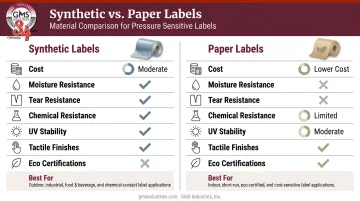
Note: synthetic labels may require specialty inks or pretreatment coatings depending on the film substrate. Paper stocks work with standard ink systems and accept premium embellishments — hot foil, spot varnish — especially on uncoated surfaces.
What Are Synthetic Labels?
Synthetic labels are made from polymer-based films — primarily polypropylene (PP), polyethylene (PE), or polyester (PET) — that are extruded, stretched, and coated to resist physical and environmental stress. Unlike paper, these films are engineered not to absorb moisture, which changes how they behave across their entire product lifecycle.
Core Performance Advantages
- Waterproof — won't absorb condensation or swell in high-humidity environments
- Tear-resistant — maintains integrity through rough handling, freezer bin abrasion, and shipping
- Scuff-resistant — print clarity survives contact that would degrade paper surfaces
- Chemical-resistant — rated for GHS-compliant labels on industrial, cleaning, and hazardous material containers
- UV-stable — resists fading under prolonged light exposure
Synthetic labels are also the standard choice for tamper-evident constructions. RFID-enabled labels — which embed a microchip and antenna for inventory tracking and traceability without line-of-sight scanning — are typically built on synthetic film substrates, making them particularly useful in pharma, logistics, and high-value product tracking.
Honest Drawbacks
The upfront material cost is higher than paper. That's a real number that shows up in quotes, and it matters for short runs or low-margin SKUs. Recyclability is also more complicated than it appears — not all PP or PET films are accepted in standard municipal recycling streams, and compatibility depends on the labeled container's material and local sorting infrastructure.
Use Cases Where Synthetic Is Non-Negotiable
- Frozen food packaging — condensation, freeze-thaw cycles, freezer bin abrasion, and retail display demands all compound into conditions paper simply can't survive
- Refrigerated beverages and dairy — continuous condensation exposure that paper cannot reliably survive
- Chemical and industrial containers — OSHA's HazCom standard requires chemical labels to remain legible and undamaged; synthetic films meet the durability requirements that paper cannot
- Health and beauty products — products that sit in showers or at sinks face repeated moisture exposure
- Pharmaceutical vials and blood bags — cryogenic and sterilization-compatible synthetic constructions are available for biological materials through collection, storage, and transport
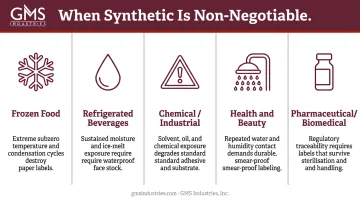
The frozen food segment alone illustrates the scale of what's at stake: the global frozen food market was valued at USD 531.5 billion in 2025 and is projected to reach USD 841.5 billion by 2033 — a growing category where label integrity directly affects shelf performance and compliance readability. GMS Industries runs flexographic label presses (Allied 300 and Mark Andy 830) specifically configured for film substrates, producing custom pressure-sensitive labels for frozen food manufacturers where these durability requirements aren't optional.
What Are Paper Labels?
Paper labels are made from wood-pulp-based stocks, and the surface finish determines both appearance and real-world performance. Three stock types cover most applications:
| Stock Type | Key Trait | Watch Out For |
|---|---|---|
| Gloss coated | Brighter print, better moisture resistance | Less embellishment-friendly |
| Uncoated | Natural texture; ideal for foil and embossing | Lower moisture resistance |
| Thermal | No ink required | Degrades faster under UV or heat |
Not all paper labels behave the same way. The stock, coating, adhesive, and any laminate applied all interact to determine real-world performance.
Core Advantages
- Costs less to produce — short runs, limited edition SKUs, and promotional packaging benefit most from paper's lower per-unit price
- Delivers tactile options synthetic films can't match — soft-touch, uncoated, and embossed finishes signal craft or premium positioning on shelf
- Supports FSC certification, biodegradable stocks, and compostable constructions for brands with sustainability requirements
- Works best for hot foil stamping, embossing, and spot varnish — uncoated paper is the default substrate for artisan food, wine, and luxury branding
Honest Limitations
Paper absorbs moisture — that single fact drives most of its limitations. Key failure points to plan for:
- Tears, wrinkles, and loses adhesion in humid or high-contact environments
- Laminating extends durability but does not match what a synthetic film delivers in a freezer case or on a chemical drum
- Adhesive failure in wet environments is a separate problem from the facestock degrading — both need to be specified correctly
- Not all paper label stocks perform equally; stock grade, adhesive, and laminate choices all affect the result
Use Cases Where Paper Performs Reliably
- Dry grocery goods — spices, dry mixes, cereals, coffee
- Bakery and confectionery — controlled ambient environments
- Shelf-stable pantry items — oils and sauces in standard retail conditions
- Cosmetics in dry retail settings — beauty products not exposed to repeated water contact
- Short-run or promotional packaging — cost efficiency and fast turnaround are often more important than long-term durability
For artisan and premium food brands, uncoated paper stocks with an internal barrier layer can handle moderate moisture exposure — a wine bottle in an ice bucket being the common test case — but adhesive selection is critical. Specialty beverage label constructions from suppliers like UPM are engineered specifically for ice-bucket and humid refrigerated storage. That's a deliberate material decision, not a capability standard paper delivers by default.
Synthetic vs Paper Labels: Which Is Better for Your Product?
There's no universal answer. The right material is determined by four practical factors.
1. Storage and Usage Environment
Start here: does the product face moisture, condensation, chemical contact, temperature extremes, or repeated rough handling? If yes to any of these, synthetic is the correct starting point.
2. Product Lifecycle
How long must the label stay legible and adhered? A short-run promotional label at ambient temperature has different requirements than a frozen meal label that will survive multiple freeze-thaw cycles before a consumer reads the cooking instructions.
3. Budget Structure
Upfront cost vs. cost of ownership are different numbers. A paper label that lifts or smears before a product sells forces reprinting, potential compliance exposure, and possible retail chargebacks. Research published in the Journal of Food Protection found that mislabeling accounted for 9% of FDA food recalls from 2002–2023 — a costly reminder that label legibility has regulatory consequences, not just aesthetic ones.
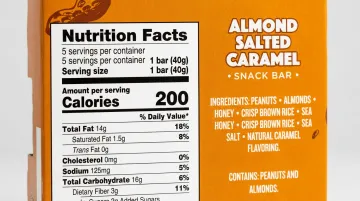
4. Brand Identity
Does your packaging need a sleek, high-clarity surface or a natural, tactile finish that signals craft or premium quality? This often points clearly toward one material.
Quick Decision Guide
Choose synthetic if your product:
- Is stored frozen or refrigerated
- Contains oils, chemicals, or hazardous materials
- Will be handled repeatedly in wet environments
- Needs to meet GHS compliance or pharma durability standards
Choose paper if your product:
- Is shelf-stable and stored in dry, controlled conditions
- Requires FSC or compostable certification for eco-positioning
- Depends on a tactile or artisan finish as part of its brand identity
- Has short production runs where cost efficiency drives the decision
Sustainability: A More Honest Picture
Once you've narrowed your material choice, sustainability is worth evaluating — but the picture is more nuanced than "paper is green, synthetic is not."
Paper labels generally carry a lower carbon footprint and offer biodegradable and compostable options where certified constructions are specified. Synthetic PP and PE films can be recyclable when compatible with the labeled container — and thinner synthetic films reduce material weight and shipping emissions versus heavier paper-based alternatives.
The Association of Plastic Recyclers notes that labels can affect automated sorting and recyclate quality, so recyclability must be evaluated at the whole-package level. The practical implication: confirm compatibility with your container's recycling stream before treating either material as inherently sustainable.
Real-World Scenarios: How Environment Drives the Decision
Scenario: Frozen Meal Manufacturer
A CPG brand producing frozen entrees faces a common cold-chain labeling problem. Paper labels applied at production look acceptable, but by the time products reach retail freezer cases, condensation has caused label edges to lift and print to smear — particularly around barcodes and expiration dates. Frost accumulation and bin abrasion compound the problem throughout the cold chain.
The switch to synthetic film labels typically comes down to three pressures:
- Retail appearance — lifted edges and smeared print damage shelf presentation
- Barcode scannability — label failure disrupts supply chain operations under GS1 standards
- Regulatory compliance — expiration dates and cooking instructions must stay legible through distribution
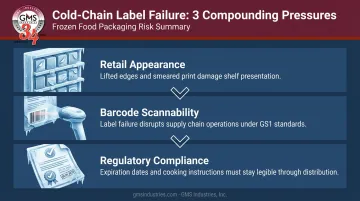
The operational results: fewer reprint runs, consistent compliance labeling across the full cold chain, and reliable shelf appearance at retail.
GMS Industries sees this scenario regularly. With anchor clients in the frozen food category and 36+ years of label production experience, the team diagnoses where in the cold chain failure is happening and specifies materials matched to that environment — not just the production floor.
Scenario: Artisan Dry Goods Brand
A specialty spice and pantry brand evaluates synthetic labels — clear polypropylene would give the product a sleek, no-label look — but ultimately chooses laminated paper instead. The product is shelf-stable, stored in dry retail conditions, and the brand's identity is built around a natural, tactile aesthetic that customers associate with quality and authenticity.
Laminated paper delivers adequate durability for the application, supports hot foil and embossing that reinforce premium positioning, and costs less per unit than synthetic film. When the environment is dry and the brand identity calls for texture, laminated paper earns its place. The performance premium of synthetic simply isn't warranted here.
Ready to evaluate your specific label environment? GMS Industries has spent 36+ years specifying labels across frozen foods, CPG, cosmetics, and industrial packaging. Tell them your product environment, and they'll tell you which material fits. Contact GMS Industries to get started.
Conclusion
The synthetic vs. paper decision is driven by where your product lives after production, not by which material looks better on a press proof.
If your label must survive moisture, freezing, chemical contact, or rough handling, synthetic film earns its higher cost through fewer label failures, legible compliance text, and a shelf appearance that holds through distribution. If your product environment is controlled and your priority is cost efficiency, eco-certification, or a tactile finish that reinforces brand identity, paper is a practical, reliable choice.
For packaging managers, getting this decision right means fewer reprint runs, lower compliance risk, and product information that stays legible throughout the supply chain — whether that's an expiration date on a frozen meal or an ingredient panel on an artisan pantry item. Teams that treat substrate selection as an afterthought tend to discover its importance at the worst possible moment: a compliance audit or a retailer rejection.
Frequently Asked Questions
What are synthetic labels?
Synthetic labels are made from polymer films — polypropylene (PP), polyethylene (PE), or polyester (PET) — engineered for durability, water resistance, and chemical resistance. Unlike paper, they do not absorb moisture or degrade in harsh environments, making them suitable for cold-chain, industrial, and wet-contact applications.
What makes a good label for food packaging?
A good food label holds print clarity through the product's full shelf life and adheres reliably in its storage environment — frozen, refrigerated, or ambient. The adhesive specification matters as much as the facestock; the wrong adhesive fails even on the right material.
What paper is used for food packaging?
Coated paper, uncoated paper (with barrier layers), and thermal paper are the most common choices. The right option depends on whether the product is shelf-stable, refrigerated, or requires a premium tactile finish for brand positioning. Not all paper stocks perform equally in contact with moisture.
Are synthetic labels more expensive than paper labels?
Synthetic labels cost more upfront, but their durability and lower reprint rates often make them less expensive over time for products in demanding environments. For shelf-stable products in controlled conditions, paper is typically the more cost-effective choice.
Can synthetic labels be used for frozen food packaging?
Yes — synthetic labels are the preferred choice for frozen food. They resist condensation, won't wrinkle or peel during freeze-thaw cycles, and maintain print clarity (expiration dates, cooking instructions, barcodes) through cold chain handling and retail freezer display.
Which label material is better for the environment?
Neither material wins outright — sustainability depends on the full lifecycle, including adhesive, container compatibility, and end-of-life disposal. Paper labels generally biodegrade and carry a lower carbon footprint; certain synthetic films (PP, PE) are recyclable when matched to the container's recycling stream.