Introduction
Pet owners read labels the way they read their own grocery lists now. They scan for named proteins, life-stage claims, and guarantees before a bag ever hits the cart.
That scrutiny turns a pet food label into two things at once: a legal document and a marketing asset. Many growing brands nail the second job and fumble the first.
A label that looks stunning on shelf but skips a required nutritional adequacy statement can trigger forced relabeling, fines, or a recall. So can naming a product "Chicken Dinner" when chicken makes up just 12% of the formula. Those mistakes are expensive and avoidable.
This guide breaks down the FDA and AAFCO rules that govern pet food labels, plus the eight elements every compliant label needs. It also covers how smart design and material choices keep your packaging both legal and shelf-ready.
Key Takeaways
- Pet food labels must satisfy FDA minimums and AAFCO's model regulations, which most states enforce as law
- Eight core elements, including guaranteed analysis and nutritional adequacy statements, belong on most labels
- AAFCO's 95%, 25%, and 3% naming rules determine how a product can be named based on formulation
- Durable materials and thoughtful design keep text legible and your brand recognizable
FDA & AAFCO: The Two Pillars of Pet Food Label Compliance
"Labeling" covers more than the sticker on your bag. Under 21 CFR Part 501, it includes written, printed, or graphic matter that accompanies the product, meaning brochures, product sheets, and website claims can all count as labeling in the eyes of regulators.
Federal rules set the floor. Individual states then layer on their own requirements, which is where AAFCO's model regulations come into play.
FDA's Role in Regulating Pet Food Labels
The FDA enforces mandatory rules on ingredient safety, sanitary manufacturing, and how ingredients get named. Under 21 CFR 501.4, every ingredient needs a specific common or usual name, listed in descending order by weight. Vague or collective terms don't pass.
Claims matter just as much as ingredients. If your marketing implies a food treats, cures, or prevents a disease, the FDA can classify that product as a "new animal drug." That classification triggers an entirely different, and far more burdensome, approval pathway.
Important nuance: the FDA doesn't pre-approve label designs before you print. Compliance is your responsibility, and enforcement typically happens after the fact. For current guidance, the FDA's animal food labeling resources are the most reliable starting point.
AAFCO's Role and the Model Regulations
AAFCO isn't a government agency. It's a nonprofit association of state feed-control officials that publishes Model Pet Food Regulations, which most states incorporate into their own laws in some form.
That distinction confuses a lot of new brand owners. AAFCO can't fine you directly, but the states that enforce its models absolutely can.
AAFCO organizes the eight required label elements across two zones:
- Principal display panel (PDP): product name, species, and net quantity
- Information panel: guaranteed analysis, ingredients, nutritional adequacy statement, feeding directions, and guarantor information
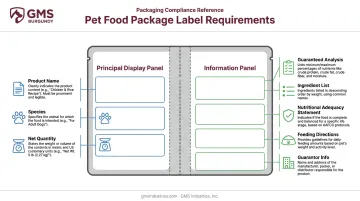
For exact specifications, check the current AAFCO Official Publication, which AAFCO updates annually. FDA scientists have historically supported AAFCO's ingredient definition process, which is part of why the two frameworks rarely conflict in practice.
Because AAFCO's specs shift with each annual update, that timing matters at the production stage, too. GMS Industries' prepress team checks ingredient statements and panel layouts against the current AAFCO and FDA requirements before running plates for pressure-sensitive pet food labels, catching compliance gaps before they reach press.
The Must-Have Elements on Every Compliant Pet Food Label
Eight elements form the compliance backbone of every pet food label. Skip one, and you risk misbranding.
Product and brand name. The name must accurately reflect ingredient content on the principal display panel. A name promising "beef" when the formula is mostly rice invites regulatory trouble.
Species designation. The label must clearly state the intended species (dog, cat, etc.), typically placed directly below the product name.
Net quantity statement. Declared in both U.S. customary and metric units, positioned within the bottom portion of the front panel. Placement is federally mandated, not left to design preference.
Guaranteed analysis. A simple format looks like this:
| Nutrient | Guarantee |
|---|---|
| Crude Protein | Min 26.0% |
| Crude Fat | Min 15.0% |
| Crude Fiber | Max 4.0% |
| Moisture | Max 10.0% |
Ingredient statement. List every ingredient individually, in descending order by weight, using AAFCO-recognized common names. Brand names, vague collective terms, and quality claims ("premium beef") don't belong here.
Nutritional adequacy statement. This clarifies which life stage the food supports, such as growth, maintenance, or all life stages.
Feeding directions. States feeding amounts based on the pet's weight, usually expressed in cups or grams per day.
Manufacturer or guarantor information. Name and address of the responsible party. If that party didn't actually make the food, the label needs "manufactured for" or "distributed by" language.
Miss any of these, and your label is incomplete before it's even inaccurate.
AAFCO Naming Rules & Avoiding Misbranding
Product names sound simple until you check the math behind them. AAFCO enforces three naming rules that dictate exactly how much of a named ingredient has to be in the formula.
The 95% Rule. For a name like "Beef Dog Food," the named ingredient must equal at least 95% of the product by weight (excluding water added for processing), or 70% including that water.
The 25%/"Dinner" Rule. Names such as "Chicken Dinner" or "Beef Entree" require the named ingredients to total at least 25% of the product excluding water, or 10% including it. Each named ingredient needs to hit at least 3%.
The 3%/"With" Rule. "Dog Food with Chicken" only requires 3% chicken by weight. This is the loosest naming tier and the easiest one to misuse accidentally.
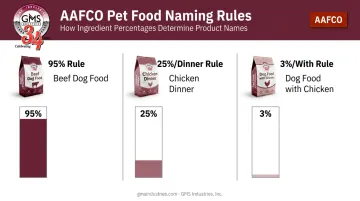
Before artwork goes final, verify the product name against the actual formulation, not the recipe you started with three revisions ago.
Getting the name right solves only part of the problem — naming compliance is one piece of a larger legal standard called misbranding. Misbranding happens when a label's claims don't match reality, when required statements go missing, or when graphics and endorsements mislead consumers. It's a prohibited act under both state and federal law.
Terms like "natural," "grain-free," and "human-grade" get consumer attention but aren't all regulated the same way:
- "Natural" has an AAFCO definition tied to production process
- "Human-grade" applies only when the entire product, not select ingredients, meets specific handling standards
- "Grain-free" has no formal AAFCO or FDA definition, which makes it a marketing term with real legal exposure if used loosely
A regulatory or legal review of label copy before your print run isn't excessive caution. It's cheaper than a reprint.
Designing Custom Pet Food Labels That Capture Attention
Treat compliance elements as design constraints from day one, not afterthoughts squeezed in once the creative concept is locked. Labels built around the required text end up looking more intentional and professional.
Building Brand Recognition Through Label Design
Consistent logo placement, color palette, and typography across a product line help pet owners spot your brand from three feet away. That matters more than most founders assume: shoppers spend an average of 20 seconds making shelf decisions, and some purchase decisions happen in as little as two.
Visual hierarchy does the heavy lifting in winning that window of attention.
Secondary panels are your best tool for brand storytelling, whether that's sourcing details, a founder's mission, or manufacturing origin. Use them to build emotional connection without crowding the front panel's required information.
Balancing Visual Appeal With Regulatory Space Requirements
Reserve legible, adequate space for the guaranteed analysis, ingredient list, and feeding directions before you design around them. Oversized graphics crowding out required text is one of the most common (and most fixable) design pitfalls in pet food packaging.
Watch out for:
- Claim badges or icons ("grain-free," life-stage graphics) that must be fully substantiated by the actual formulation
- Font sizes shrunk to fit decorative elements, making mandatory text hard to read
- Background imagery that reduces contrast on required panels
A badge your ingredient list doesn't support is a misbranding risk.
Choosing Materials & a Printing Partner for Compliant, Durable Labels
Material choice affects legibility just as much as font size. Wet food, treats, and anything stored in humid environments need moisture- and grease-resistant substrates, such as BOPP or synthetic films, often finished with lamination or UV coating.
Without that protection, guaranteed analysis text can smear or peel before the product sells through, which creates a compliance gap even if the original artwork was perfect.
What to look for in a printing partner:
- Experience catching compliance issues (missing statements, incorrect panel placement) before a full print run
- Prepress tools that verify color, layout, and text accuracy prior to plating
- Printing methods (flexo, litho, digital) that match your run size and turnaround needs
- Manageable minimum order quantities for a first production run
This is where an experienced label manufacturer earns its keep. GMS Industries has spent over 30 years producing pressure sensitive labels, folding cartons, and packaging for food and CPG brands. Its long-standing frozen foods clients manage the same ingredient declarations, allergen callouts, and net weight requirements that pet food labels demand.
GMS runs custom labels through flexo, litho, and digital printing, backed by prepress tools like Fuji Final Proof and ICC color profiling that catch layout and color issues before they become a reprint.
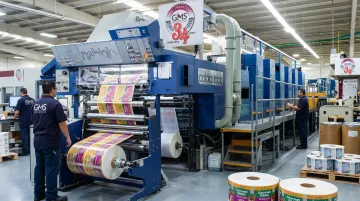
Minimum orders start at 1,000 labels, a workable entry point for a first production run. Brands can connect with the GMS team to talk through substrate options and compliance-friendly layouts before committing to a print run.
Frequently Asked Questions
What must be on a pet food label by law?
Federally, labels need product identification, net quantity, an ingredient list, and manufacturer information. Most states also require the guaranteed analysis, set by AAFCO (the Association of American Feed Control Officials), and nutritional adequacy statement.
Is AAFCO approval required for pet food?
No. AAFCO doesn't approve products directly. It's a nonprofit that publishes model regulations, and most states adopt these into law. That makes compliance effectively required even without direct AAFCO enforcement.
What is the AAFCO 95% rule?
Named ingredients must make up at least 95% of the product (or 70% including added water) for names like "Beef Dog Food." A formula that's only 60% beef can't legally use that name.
How do I know if my pet food label is compliant?
Cross-check your label against FDA's 21 CFR Part 501 and the current AAFCO Official Publication. A regulatory consultant or experienced label printer can also review it before production.
What labeling mistakes commonly get pet food products flagged or recalled?
Unsubstantiated health claims, product names that don't match actual ingredient percentages, missing nutritional adequacy statements, and misleading graphics top the list.
What's the best label material for pet food packaging?
Moisture-resistant synthetic or BOPP materials with lamination suit bags and pouches exposed to humidity. Foil or textured stocks (produced in-house by GMS Industries) work well for premium dry food positioning.