Introduction
A package insert that patients can't read is worse than no insert at all. When a Spanish-speaking patient sees "once daily" on a label and interprets "once" as the Spanish word for eleven, the result isn't confusion—it's a potential overdose. That real-world near-miss, documented in a peer-reviewed study of Spanish medicine labels, illustrates exactly why multilingual package insert translation is a patient safety function, not a formatting task.
This guide covers the full process of converting a product's enclosed informational document (dosage, warnings, ingredients, usage instructions) into multiple languages for global or domestic multilingual markets. It walks through what's required, how the process works step by step, and where teams most commonly go wrong. It's written for pharmaceutical manufacturers, nutraceutical brands, consumer packaged goods companies, and cosmetics producers.
Key Takeaways
- The EU requires translations into all 24 official languages for centralized drug approval; the US has no federal equivalent.
- More than 25 million people in the US have limited English proficiency—a population that depends on accurate translated labeling.
- Translation alone doesn't equal compliance—regulatory review, formatting, and readability testing are all required steps.
- Text expansion in translated content can affect physical insert design; production partners must account for this.
- Regulatory bodies reject machine translation for patient-facing inserts without full human expert review.
What Is Multilingual Package Insert Translation?
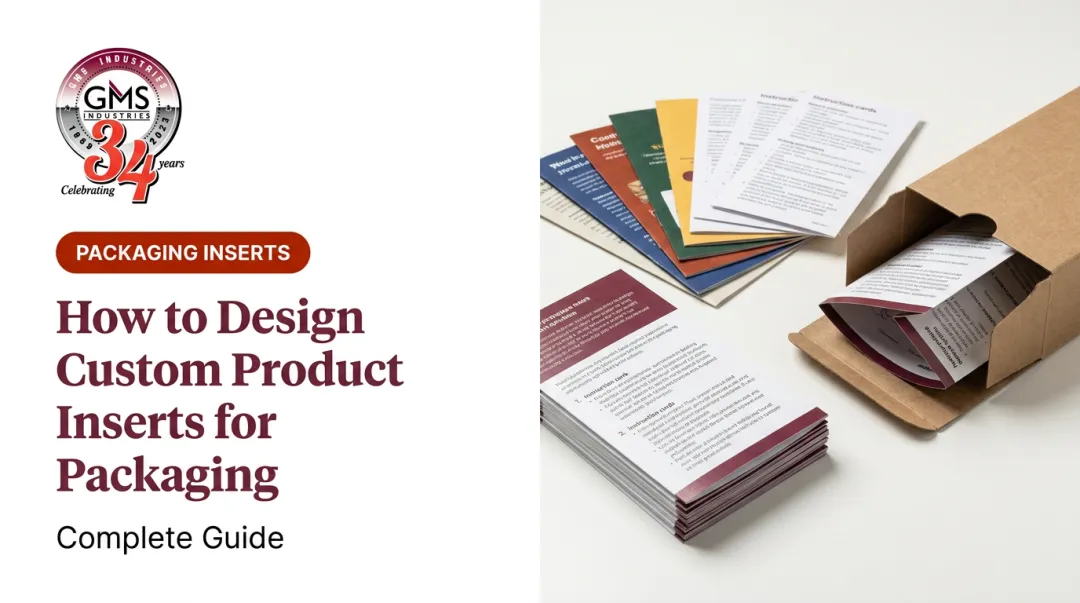
A package insert—also called a patient information leaflet (PIL) or prescribing information—is the folded document enclosed with a pharmaceutical, nutraceutical, or consumer product. It communicates dosage instructions, contraindications, side effects, storage requirements, and regulatory warnings.
Under EU law, the EMA defines product information for human medicines as comprising the Summary of Product Characteristics (SmPC), labelling, and package leaflet. In the US, the FDA describes prescribing information as the approved document containing essential scientific information for safe and effective use.
What Gets Translated
The scope of translation includes:
- Outer carton text
- Immediate packaging labels
- The full patient information leaflet or insert
- Country-specific regulatory disclosures (such as the EU "blue box," the area on outer packaging reserved for member-state-specific information under Directive 2001/83/EC Article 57)
Translation vs. Localization
- Translation converts text from one language to another with linguistic accuracy
- Localization adapts additional elements—units of measurement, date formats, telephone numbers, legal disclaimers, and culturally appropriate phrasing—to the target country's standards
A document that's accurately translated but retains US date formats and FDA-specific legal language will still fail a regulatory review in an EU member state. Both steps are required.
Why Multilingual Package Insert Translation Matters
Patient Safety
AHRQ research shows that adverse events affect patients with limited English proficiency more frequently, are often caused by communication problems, and are more likely to result in serious harm. The "once daily" / Spanish "once" (eleven) error illustrates the stakes directly: documented in published label research and a reported near-miss, a patient took eleven pills daily because an untranslated English dosing term appeared on a Spanish-language label.
That type of error is predictable when dosing terms go untranslated — and with more than 25 million LEP individuals in the US (9% of the population), the scale of exposure is substantial.
EU Regulatory Requirements
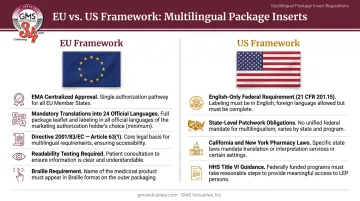
The EU has maintained a mandatory multilingual insert requirement since the adoption of Directive 2001/83/EC. Key requirements include:
- Article 63(1): Labeling and the package leaflet must appear in the official language(s) of each member state where the product is placed on the market
- Article 56a: The product name must be expressed in Braille on packaging
- Article 59(3): The package leaflet must reflect consultations with target patient groups to confirm it is legible, clear, and easy to use
For centrally authorized products, EMA linguistic review requires translations into all EU languages. Marketing authorization holders send translations to Member State Contact Points for Translations by Day +5 after the CHMP opinion—which means translation workflows must be underway before the opinion issues, not after.
The US Regulatory Gap
The FDA does not require multilingual package inserts. Under 21 CFR 201.15(c)(1), all required drug labeling information must appear in English. One important trigger: if any representation appears in a foreign language, all required statements must also appear in that language.
That said, practical compliance pressure comes from multiple directions:
- California Business and Professions Code Section 4076.6 requires dispensers to provide translated directions for use upon patient request
- New York Education Law Section 6829 requires covered pharmacies (groups of eight or more under common ownership) to provide free interpretation and translation services to LEP individuals
- HHS Title VI guidance requires recipients of federal financial assistance to take reasonable steps to provide meaningful access to LEP persons
These are pharmacy-level obligations, not manufacturer package-insert mandates. But companies that ignore them—or that launch into states with large LEP populations without any translated materials—face real liability exposure.
Beyond Pharmaceuticals
The translation obligation extends across product categories:
- EU Medical Devices: MDR Article 10(11) requires device information to be in official Union languages determined by each member state
- EU Cosmetics: Regulation 1223/2009 Article 19(5) leaves required label language to member-state determination
- Nutraceuticals and OTC consumer health products: Subject to equivalent state-level labeling frameworks and FTC accuracy requirements across all languages used
For companies managing product lines across multiple categories — a supplement line alongside an OTC topical, for example — this means translation obligations compound quickly. Each category carries its own regulatory reference points, and a single insert strategy rarely covers all of them.
How the Multilingual Package Insert Translation Process Works
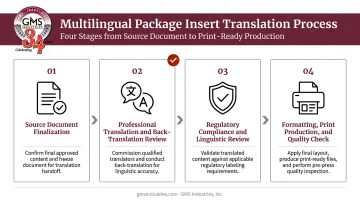
The process moves through four sequential stages. Each has defined quality gates. Skipping or rushing any stage creates compounding errors that are expensive to fix downstream.
Step 1: Source Document Finalization
Translation cannot begin until the source document—typically in English—has received final regulatory approval and content sign-off. Any post-translation change to the source requires re-translation of affected sections, which cascades across every language version in scope.
Smart teams use the approval period productively: building glossaries of approved terminology, creating style guides, and scoping language requirements so translation can begin immediately after sign-off.
Step 2: Professional Translation and Back-Translation Review
Qualified translators for pharmaceutical and regulated consumer health content need dual expertise:
- Fluency in the target language
- Domain knowledge in pharmaceutical science, regulatory terminology, or consumer chemistry
General-purpose translators—and machine translation used without human expert review—are not appropriate for regulated pharmaceutical content. Regulatory bodies do not accept machine-translated inserts without full expert sign-off.
Back-translation is a widely used quality control method: a second independent translator converts the translated text back into the source language to verify no meaning has been altered. This is standard practice in clinical trial translation and strongly recommended for patient-facing inserts.
ISO 17100:2015 is the recognized international standard for professional translation service processes. Confirming that your translation agency holds this certification is a baseline quality check.
Step 3: Regulatory Compliance and Linguistic Review
Translated content must be validated against the specific regulatory requirements of each target market. This includes:
- Required disclosures and warnings
- Font size minimums and contrast requirements
- Country-specific additions (EU member states require a blue box for market-specific information such as pricing and reimbursement conditions)
- Braille requirements for product name on packaging
In the EU, this step also involves the formal EMA linguistic review process for centrally authorized products. Some member state agencies review translated mock-ups before final submission. Coordinating with those agencies in advance can prevent late-stage rejections.
Step 4: Formatting, Print Production, and Quality Check
Once translations are reviewed and approved, the insert must be reformatted for physical production. This involves:
- Desktop publishing (DTP) to reflow multilingual text into the required insert dimensions
- Maintaining legibility requirements (font size, contrast, readability)
- Accommodating text expansion: translated text often expands relative to the English source, and shorter strings tend to expand more sharply than longer ones
Once text is finalized, the physical production stage demands a packaging manufacturer experienced in precise multilingual layouts and tight dimensional tolerances.
GMS Industries specializes in printed instruction sheets and folding cartons, producing multi-language inserts with text in up to five languages on a single document. Their bindery and finishing equipment, including a Polar 54" automated cutting system, Muller saddle-stitch binders, and Watkiss collator, handles the complex multi-panel configurations that regulated inserts typically require.
Key Factors That Affect Translation Quality and Compliance
Translator Qualifications
Using a general translation agency without sector-specific linguists introduces error risk in medical terminology, contraindication language, and regulatory phrasing. Confirm ISO 17100 certification and request evidence of subject-matter expertise before engaging any translation provider for regulated content.
Text Expansion and Physical Space
Translated text expands. W3C internationalization guidance (based on IBM research) confirms that shorter English strings expand more dramatically than longer ones. This affects how the insert must be designed, folded, and printed.
Small packaging units face additional constraints: HPRA guidance defines small immediate packaging units as containers up to and including 10 ml, where only minimum labeling particulars are required. Factor these space constraints into the layout before translation begins, not after.
Regulatory Fragmentation
A single product sold in five countries may face five different regulatory frameworks for:
- Required content and disclosures
- Formatting mandates
- Language scope
The EU's centralized EMA approval process cascades a single authorization to all member states, which simplifies the compliance structure. The US has no equivalent mechanism — language-access obligations arise from a patchwork of state laws and federal civil rights guidance, which companies must map independently for each market they serve.
Terminology Consistency
Consistency across a multi-language insert — and across product line updates over time — depends on consistent terminology management. CAT (computer-assisted translation) tools store approved translations of standardized phrases and medical terms, preventing divergent terminology across language versions. The EMA's QRD templates serve a similar function at the regulatory level, providing standardized product-information wording across SmPC, labelling, and package leaflet.
Working without terminology management tools, or abandoning them mid-project, produces inconsistencies that regulators and QA reviewers flag during submission review.
Common Mistakes in Package Insert Translation
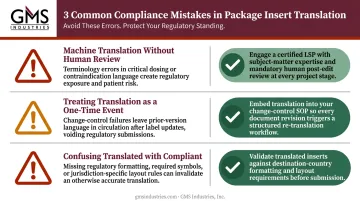
Three mistakes account for most compliance failures in multilingual insert programs:
Relying on machine translation without human expert review. For regulated pharmaceutical inserts, AI tools cannot reliably handle specialized medical terminology, nuanced contraindication language, or culturally appropriate phrasing. No regulatory body accepts machine-translated patient-facing inserts without full human review and sign-off.
Treating translation as a one-time event. Product inserts must be updated whenever the approved SmPC or source text changes. Companies without a defined change-control process for translated documents find their inserts out of sync with the approved source—creating a regulatory violation across every market where that version is in use.
Confusing "translated" with "compliant." A linguistically accurate translation can still fail regulatory review if it lacks country-specific disclosures, misses formatting mandates, or doesn't meet readability standards.
The EU makes this distinction explicit: Directive 2001/83/EC Article 59(3) requires consumer readability testing of patient information leaflets as part of the marketing approval process. Linguistic accuracy is a necessary condition for compliance—not a sufficient one.
Frequently Asked Questions
What is multilingual package insert translation?
It's the professional process of converting a product's enclosed information document into multiple languages to meet regulatory requirements and serve multilingual patient populations. It applies to pharmaceuticals, nutraceuticals, consumer health products, medical devices, and cosmetics.
What are the FDA requirements for multilingual package insert translation?
The FDA requires labeling information in English only under 21 CFR 201.15(c)(1) and does not mandate multilingual package inserts for US distribution. State-level laws in California and New York create pharmacy-level translation obligations, and HHS Title VI guidance applies language-access requirements to recipients of federal financial assistance.
What languages are typically required for multilingual package inserts?
Required languages depend on the target market. EU centralized approval requires all 24 official EU languages; US products should prioritize languages spoken by the largest LEP communities in their distribution region. For global products, conduct a language scoping assessment before source document finalization to avoid costly revisions later.
What is the difference between package insert translation and localization?
Translation converts text from one language to another. Localization also adapts units of measurement, date formats, legal disclaimers, and culturally appropriate phrasing to the target country's standards. Both are typically required for a fully compliant international insert.
How long does multilingual package insert translation typically take?
Timelines depend on language count, document complexity, and destination market. EU submissions must reach Member State Contact Points by Day +5 after the CHMP opinion, so planning ahead is essential. A quality-controlled translation cycle for a standard insert typically runs four to twelve weeks.
What are the risks of inaccurate package insert translations?
The primary risks are patient harm from misunderstood dosage or contraindication information—illustrated by the documented "once daily" / Spanish "once" (eleven) labeling error—regulatory non-compliance that can block market access or trigger product action, and legal liability exposure. In regulated markets, inaccurate translations are a compliance failure.