Introduction
Consumers decide whether a product is worth its price before they ever open it. The weight of the box in their hands, the precision of its corners, the resistance of its lid — these physical signals happen in seconds and shape brand perception instantly.
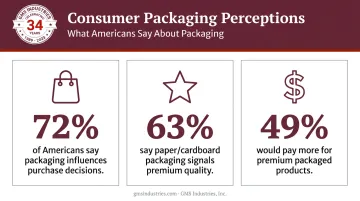
According to Ipsos, 72% of Americans say packaging design influences their purchase decisions, and 63% say paper and cardboard packaging makes products appear premium or high quality. In markets where perception drives pricing, packaging is part of the product.
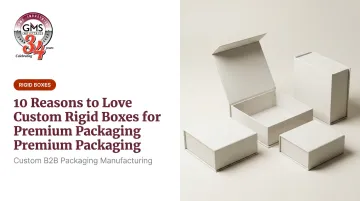
Custom rigid boxes have become the benchmark for premium packaging across cosmetics, electronics, gifting, and consumer goods. They protect products, signal brand quality before a word is read, and create unboxing experiences customers remember — and talk about.
This article breaks down 10 concrete reasons why custom rigid boxes are a smart packaging investment — covering structure, branding, customer experience, and the business case behind the format.
Key Takeaways
- Custom rigid boxes signal premium quality before the product is even seen
- Their thick chipboard construction protects against crushing and damage during transit
- 41% of consumers say premium unboxing experiences increase their desire to repurchase
- Rigid boxes can be made with recyclable, FSC-certified materials without sacrificing aesthetics
- In cosmetics, gifting, electronics, and consumer goods, rigid boxes double as a brand ambassador
What Are Custom Rigid Boxes?
Custom rigid boxes — also called set-up boxes — are built from thick chipboard or greyboard, typically ranging from 36 to 120 pt, as defined by the Paperboard Packaging Council. A decorative or printed paper wrap is applied over the board structure. Unlike folding cartons, they are pre-assembled and do not collapse flat.
Folding cartons are lightweight and built for high-volume efficiency — easy to store flat, fast to assemble at scale. Rigid boxes serve a different purpose: they hold their shape permanently, resist compression, and signal premium quality through weight and structure the moment someone picks them up.
Common applications include:
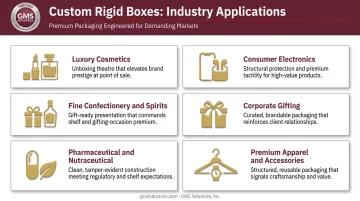
- Luxury cosmetics and skincare
- Consumer electronics
- Fine confectionery and spirits
- Corporate gifting and subscription boxes
- Pharmaceutical and nutraceutical products
- Premium apparel accessories
The box itself becomes part of the product experience. For brands where first impressions drive purchase decisions, that physical presence is the point — not a secondary consideration.
10 Reasons to Love Custom Rigid Boxes for Premium Packaging
Reason 1: Superior Structural Strength and Product Protection
Rigid boxes are built from high-density chipboard that is several times thicker than standard cardboard. This construction resists crushing, denting, and corner damage during shipping and storage in ways that folding cartons simply cannot match.
For products with high unit values — a skincare set, a gift bundle, a consumer electronics accessory — arriving damaged is not just a logistical problem. It is a brand problem. With US retail returns projected at $890 billion in 2024 and 16.9% of annual sales returned, reducing damage-driven returns has direct bottom-line consequences.
The thick-board structure of rigid boxes makes them measurably more resistant to the pressure and impact of standard shipping conditions. That structural advantage translates into fewer replacements, fewer return claims, and stronger customer satisfaction scores.
Reason 2: A Premium First Impression That Shapes Brand Perception
Packaging is the first physical touchpoint a customer has with a product. The weight, texture, and rigidity of a set-up box communicates quality before the lid is even lifted.
Research supports this clearly. 63% of Americans say paper and cardboard packaging makes products appear premium, and 49% say they would pay more for products packaged this way. A peer-reviewed study published in PLOS One found that package weight increases of 21% to 27% affected product desire and willingness to pay — a tangible demonstration that haptic signals shape perceived value.
For brands using premium pricing strategies, a rigid box with crisp corners, a tight-fitting lid, and a smooth printed wrap signals that what's inside is worth the price on the tag. The packaging communicates value before the customer reads a single word.
When packaging feels expensive, the product inside feels more valuable. That is not superficial — it is how perception drives purchase behavior in cosmetics, gifting, and consumer goods.
Reason 3: An Unboxing Experience That Builds Customer Loyalty
Opening a rigid box is not the same as tearing into a folding carton. Whether it's a magnetic closure that releases cleanly, a ribbon pull that lifts an inner tray, or a lift-off lid revealing a product nestled in a molded insert: the experience is deliberately paced and tactile.
Academic research describes unboxing as a consumption practice that creates emotional engagement before the product is even assessed. The commercial evidence backs this up: 41% of consumers say premium unboxing experiences increase their desire to buy from a brand again, according to a PMMI-cited study reported by Packaging Technology Today.
Google's research found that 62% of viewers watched unboxing videos while actively researching a product, with unboxing views growing 57% year over year. Organic engagement at that scale starts with a packaging experience worth filming.
Brands that invest in a memorable unboxing moment earn more than a single sale — they earn the kind of loyalty that shows up in repeat purchases and word-of-mouth recommendation.
Reason 4: Extensive Customization Options for Every Brand Aesthetic
One of the strongest operational advantages of custom rigid boxes is the range of design choices available — structural and surface — without sacrificing manufacturing integrity.
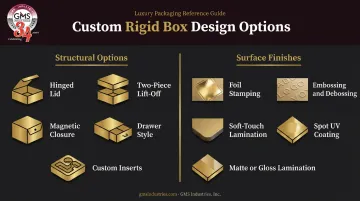
Structural options include:
- Hinged lid and two-piece lift-off designs
- Magnetic closure boxes
- Drawer-style configurations
- Booklet and specialty formats
- Custom foam, cardboard divider, or molded pulp inserts to hold products securely
Surface finish options include:
- Foil stamping (gold, silver, custom colors)
- Embossing and debossing for tactile dimension
- Soft-touch lamination for a velvety matte feel
- Spot UV coating for selective gloss contrast
- Matte or gloss overall lamination
Each finish option serves a different brand positioning goal. Soft-touch lamination with debossed type reads as understated luxury. Foil stamping and spot UV read as bold and high-impact. The choice is not aesthetic preference alone — it is a branding decision that communicates directly to the customer at the moment of first contact.
GMS Industries offers custom rigid box manufacturing with samples available on request. Brands looking to explore structural and finish options can contact the team at kris@gmsindustries.com to discuss specifications for their specific product and market.
Reason 5: Retail Shelf Presence and Display Impact
Rigid boxes maintain their shape perfectly on retail shelves. Unlike flexible packaging that sags or folding cartons that can bow under their own weight, a rigid box holds its geometry precisely — clean edges, square corners, consistent height.
NielsenIQ reports that shoppers make purchase decisions in just 19 seconds, and optimized packaging designs generate an average 5.5% lift in forecasted revenue. In that environment, packaging that holds its shape and projects quality is not optional — it is competitive.
For brands sold at point of purchase, the rigid box does specific work: it signals premium pricing before the customer reads a single word. The physical presence of the box — its weight when picked up, its resistance when handled — justifies the price point through sensation alone.
Reason 6: Reusability That Keeps Your Brand in View
The durability and aesthetic quality of rigid boxes means customers keep them. A well-made rigid box becomes a storage container, a display piece, a drawer organizer — and every day it sits on a shelf, it reinforces brand recall at zero additional cost.
Tiffany & Co. has built an entire brand identity around this principle. Their Blue Box is protected intellectual property — valued as part of a trademark system appraised at $5.8 billion — precisely because customers retain it, display it, and associate it with the brand long after the purchase.
Passive brand exposure through retained packaging is one of the most undervalued benefits of the rigid box format. Folding cartons enter the recycling stream immediately. A well-made rigid box earns shelf space for months or years.
Reason 7: Eco-Friendly Material Options Without Sacrificing Luxury
Sustainability and premium aesthetics are not in conflict when it comes to rigid boxes. Chipboard and greyboard substrates can be produced from recyclable materials and FSC-certified sources. Printed wraps can use water-based or soy-based inks. The result is a packaging format that meets environmental expectations without downgrading the visual or tactile experience.
McKinsey's 2025 research on US consumer packaging preferences found that recyclability is the top sustainability trait for 77% of US consumers, and paper and cardboard rank second among materials perceived as sustainable. For eco-conscious segments in cosmetics, wellness, and food, sustainable premium packaging has become a genuine purchase driver.
Tiffany & Co. itself — one of the most recognized premium packaging examples globally — states that its Blue Boxes are 100% FSC-certified and made with recyclable paper. The environmental credential does not diminish the luxury signal. It reinforces it.
The inherent reusability of rigid boxes also extends material life, reducing waste compared to single-use packaging formats that enter the recycling stream immediately after opening.
Reason 8: Versatility Across Premium Industries
Custom rigid boxes are not category-specific. The same structural format adapts to vastly different product shapes, weights, and regulatory requirements across a wide range of industries.
Industries where rigid boxes deliver measurable impact:
- Luxury cosmetics and skincare — product protection plus prestige signal at retail and DTC
- Consumer electronics — structural protection for high-value items, Apple being the most recognized example
- Fine confectionery and spirits — Johnnie Walker Blue Label's limited-edition gift packaging delivered 100% sales growth versus the prior year while reducing cost of goods by 20%
- Pharmaceutical and nutraceutical products — tamper-evident closures and product integrity
- Corporate gifting — presentation quality that reflects the giver's brand standards
- Premium apparel and accessories — unboxing experience as part of the brand narrative
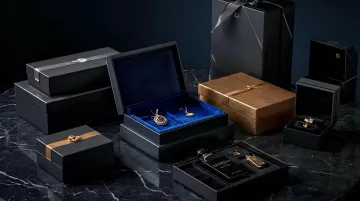
GMS Industries serves clients across cosmetics, consumer goods, pharma, and food packaging — with rigid box production running across both the El Paso, TX and Mexicali, MX facilities. That dual-facility setup supports programs ranging from short-run custom samples to high-volume production runs.
Reason 9: Reduced Returns and Lower Cost-Per-Delivery
Every damaged product that reaches a customer creates a chain of costs: replacement manufacturing, reverse logistics, customer service labor, and the reputational damage of a negative review. With US retail returns already at $890 billion annually, brands in premium categories cannot afford packaging that contributes to that number.
The thick-board construction of rigid boxes directly reduces transit damage. Products arrive intact. Inserts keep items precisely positioned. Lids protect contents from pressure and compression. The result is fewer claims, fewer replacements, and cleaner customer satisfaction data.
The higher upfront cost of a rigid box versus a folding carton looks different when measured against the cost of a damaged-product return. For high-value SKUs, the math typically favors the premium packaging option.
Reason 10: Long-Term Brand Equity and Perceived Value
Packaging is not a one-time communication. Every order a customer receives, every box they keep, every unboxing moment they share — these build an accumulating association between the brand and quality. Brand equity built through packaging compounds over time.
Consistent use of premium packaging trains customers to expect quality. Over time, that expectation supports stronger pricing power, higher customer lifetime value, and greater resistance to competitive pressure. The Tiffany Blue Box is the clearest proof: a box has become more recognizable than many of the products it contains.
For brands in competitive markets, custom rigid boxes are not a cost center. They are a brand-building investment — one that compounds through repeat purchases, premium pricing authority, and the loyalty of customers who feel their purchase was genuinely worth it.
What Brands Lose When They Skip Custom Rigid Packaging
The risks of under-investing in packaging are concrete, not theoretical.
Structural risk: Products packaged in insufficient materials are more vulnerable to transit damage. Damaged arrivals generate returns, replacement costs, and negative reviews — all of which are harder to recover from in premium markets where customer expectations are highest.
Perception risk: When packaging looks generic or feels flimsy, it creates a price-value mismatch. Customers who pay a premium price and receive standard packaging subconsciously question the product's worth. That doubt increases price sensitivity and reduces conversion on repeat purchases.
Opportunity cost: Without a memorable unboxing moment or distinctive shelf presence, brands miss the organic social sharing, repeat purchase motivation, and word-of-mouth that premium packaging actively generates. NielsenIQ's research shows packaging optimization averages a 5.5% revenue lift — generic packaging forfeits that upside entirely.
Each of these risks compounds the others. A damaged shipment triggers a refund; a refund interaction surfaces the flimsy packaging; the customer doesn't come back. Custom rigid packaging interrupts that chain before it starts.
Conclusion
Custom rigid boxes deliver value at every stage of the customer relationship — from the first impression on a retail shelf to the unboxing moment at home to the box that stays on a customer's desk for years. That range of impact makes them one of the highest-leverage packaging investments a premium brand can make.
GMS Industries has spent 36 years manufacturing custom packaging for brands across cosmetics, consumer goods, pharma, and food. Their rigid box capabilities include custom structural configurations, lift-lid and two-piece set-up formats, and surface finishes from soft-touch lamination to foil stamping — with samples available on request at kris@gmsindustries.com.
If your current packaging isn't reinforcing the value of what's inside it, a custom rigid box is a direct fix. Request a sample to see the difference firsthand.
Frequently Asked Questions
What are the benefits of custom rigid boxes?
Custom rigid boxes offer superior product protection, a premium brand perception at first touch, and a memorable unboxing experience that drives repeat purchases. For brands in premium categories, they also build long-term brand equity by training customers to associate consistent quality with the brand.
Are custom rigid boxes worth the higher cost?
For premium-positioned brands, yes. The reduction in transit damage and returns, combined with the brand loyalty and perceived value they generate, offsets the higher upfront cost.
How are custom rigid boxes different from folding cartons?
Rigid boxes are pre-assembled from thick chipboard and do not fold flat, making them structurally stronger and more premium in appearance. Folding cartons are lighter, foldable, and better suited for high-volume, standard-tier products where shelf efficiency outweighs presentation.
What industries use custom rigid boxes?
Common applications include:
- Luxury cosmetics and skincare
- Consumer electronics
- Fine confectionery and spirits
- Pharmaceutical and nutraceutical products
- Corporate gifting and premium apparel
Can custom rigid boxes be made with eco-friendly materials?
Yes. Rigid boxes can be produced with recyclable chipboard, FSC-certified substrates, and eco-friendly inks. Their inherent reusability also extends material life, reducing environmental impact compared to folding cartons and poly bags.
What customization options are available for custom rigid boxes?
Structural options:
- Hinged lids, magnetic closures, drawer styles, two-piece lift-off designs
- Custom inserts for product positioning and protection
Surface finishes:
- Foil stamping, embossing, and debossing
- Soft-touch lamination, spot UV, and matte or gloss coatings