Introduction
Picture a shopper with a peanut allergy standing in the cereal aisle, turning a box over to read "may contain peanuts." Is that a real warning or just legal caution? Even food scientists disagree on the answer sometimes.
This voluntary phrase, known as Precautionary Allergen Labelling (PAL), creates confusion on both sides of the shelf. Allergic consumers don't know whether to trust it, and manufacturers don't always know when to use it.
Most people assume PAL works like mandatory allergen labelling. It doesn't. One is a legal requirement; the other is a judgment call brands make on their own, with almost no consistent rules behind it.
This article breaks down what PAL actually means, whether any law requires it, why manufacturers use it anyway, and how to label responsibly without over-warning or under-protecting customers.
Key Takeaways
- PAL wording like "may contain" is voluntary and unregulated in most countries, including the US
- Mandatory allergen declaration for intentionally added ingredients is legally required in nearly 100 countries
- Research shows PAL wording doesn't reliably signal risk level, leading to widespread consumer confusion
- Global bodies like FAO/WHO and Codex are pushing toward a standardized, risk-based PAL framework
- Brands reduce risk by combining formal risk assessment with clear, consistent label design
What Is Precautionary Allergen Labelling (PAL)?
PAL is a precautionary statement that warns consumers about the possible unintended presence of an allergen. This differs entirely from an ingredient added on purpose.
The distinction matters. PAL addresses cross-contact, meaning an allergen entering a product through shared equipment, shared facilities, or a shared supply chain, not because a recipe calls for it.
This risk-communication tool emerged in the late 1980s as an industry response to allergic consumers' safety concerns. Manufacturers created it on their own initiative, trying to protect allergic customers without any standardized playbook to follow.
That's still mostly true today. Intentionally added allergens fall under strict mandatory labelling laws. Unintended allergen presence from cross-contact does not, at least not in most countries.
Common PAL Wording You'll See on Packaging
Walk any grocery aisle and you'll spot several variations of the same warning:
- "May contain [allergen]"
- "May contain traces of [allergen]"
- "Manufactured in a facility that also processes [allergen]"
- "Made on shared equipment with [allergen]"
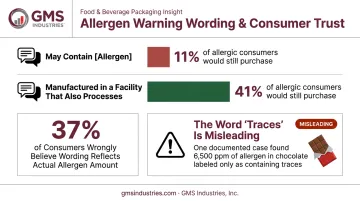
Here's the problem: these phrases sound different, but they don't actually communicate different levels of risk. A FARE-reported survey of US and Canadian consumers found that 37% of respondents believed PAL wording reflected the actual amount or likelihood of allergen present. It doesn't, at least not consistently.
The same research found purchasing behavior shifted dramatically based on wording alone. Only 11% of allergic consumers said they'd buy a product labelled "may contain," compared to 41% for "manufactured in a facility that also processes" the same allergen. Same underlying risk, wildly different consumer trust.
That confusion extends to specific word choices, too. Allergy experts and regulators, including Health Canada, actively discourage the word "traces." It implies a negligible amount. Health Canada's own review found chocolate products carrying "trace" warnings with allergen concentrations as high as 6,500 ppm, hardly a trace by any reasonable measure.
Is PAL Legally Required? Mandatory vs. Voluntary Allergen Labelling
This is where most confusion starts: mandatory declaration and PAL sound related, but they're regulated in completely different ways.
Mandatory Allergen Declaration Laws
Nearly 100 countries require manufacturers to declare major allergens when they're intentionally used as ingredients. This isn't optional. Codex Alimentarius maintains a "big 8" list: cereals containing gluten, crustaceans, eggs, fish, peanuts, soybeans, milk, and tree nuts.
In the US, FALCPA established eight major allergens: milk, egg, fish, crustacean shellfish, tree nuts, peanuts, wheat, and soybeans. The FASTER Act added sesame as the ninth major allergen, effective January 1, 2023.
US law goes further than just naming a category. Labels must identify:
- The specific tree nut (almond, walnut, cashew)
- The specific fish species (cod, salmon, tuna)
- The specific crustacean species (shrimp, crab, lobster)
Manufacturers declare this information either directly in the ingredient list, such as "whey (milk)," or through a "Contains" statement placed immediately after the ingredient list.
The Regulatory Gray Area Around PAL
Here's the part that surprises most brands: PAL isn't legally required in the US. FDA guidance permits voluntary advisory statements, but only when they're truthful and not misleading; PAL cannot substitute for Good Manufacturing Practices or genuine cross-contact prevention.
A handful of countries have moved past voluntary guesswork by setting hard thresholds:
- Japan requires declaration when allergen presence hits 10 ppm or more, whether intentional or from cross-contact
- Switzerland requires declaration above 1,000 ppm for unintentionally present allergens
- Czech Republic uses allergen-specific limits, roughly 1-2.5 ppm as a lower bound and 10-50 ppm as an upper bound, with PAL optional in between
The rest of the world is watching closely. FAO and WHO reconvened an Expert Consultation in 2021 to establish reference doses for priority allergens. Codex has agreed to adopt international PAL guidelines built on science-based action levels, aiming for consistent "may contain" wording placed near the ingredient list.
Why Food Manufacturers Use PAL
Even with strict Good Manufacturing Practices and HACCP protocols in place, some cross-contact risk is nearly impossible to eliminate. Shared production lines, shared warehouses, and shared suppliers all introduce risk that no amount of cleaning fully removes.
PAL has become the industry's default answer. And it's everywhere:
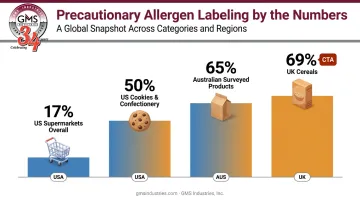
- 17% of products across 20,000+ items in 99 US supermarkets carried PAL, rising to over 50% of cookies and confectionery products
- An Australian survey of 1,355 products found PAL on 65% of them
- A UK audit found nut PAL on 69% of cereals, even when nuts weren't an actual ingredient
There's another motive beyond safety communication: liability. A survey of 84 Canadian food processors found 30% ranked legal liability as their top concern when deciding whether to apply PAL. Another 48% reported using internal thresholds, mostly for gluten and sulphites.
The catch? Slapping "may contain" on a label doesn't automatically protect a manufacturer from liability.
Industry guidance is clear: real protection requires documented risk assessments and actual manufacturing practices behind every PAL decision.
The Problem: Inconsistent PAL Confuses Consumers and Costs Brands Trust
PAL was supposed to help allergic consumers make safer choices. In practice, it's often doing the opposite.
A peer-reviewed survey of 6,684 US and Canadian respondents found 46% were unsure or incorrectly believed PAL was legally required. Another 37% assumed the wording reflected the actual amount of allergen present, an assumption the data simply doesn't support.
The inconsistency runs both directions. Testing across 544 European cookies and chocolates found peanut in 32% of products carrying PAL and 25% of products without any PAL at all. A separate Irish study found undeclared allergen in 11% of products with no PAL versus 6.5% of products that did carry a warning.
Translation: PAL doesn't guarantee an allergen is present, and its absence doesn't guarantee safety either.
This creates a real business problem, not just a consumer one:
- Overusing PAL as a blanket safety net shrinks a brand's addressable market unnecessarily
- Eroding consumer trust through warnings that feel arbitrary or overcautious
- Skipping PAL when it's actually warranted creates genuine safety and liability exposure
Neither extreme serves the brand or the consumer. The real fix is accuracy: PAL should reflect genuine risk data, not blanket caution or its absence.
Best Practices for Implementing Accurate, Clear PAL on Your Packaging
Getting PAL right starts long before a label goes to press. It begins with knowing your actual risk, not guessing at it.
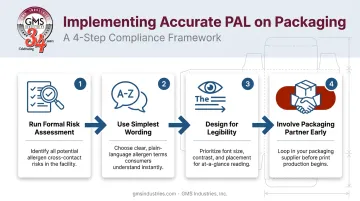
Run a formal risk assessment first. Frameworks like the Allergen Bureau's VITAL program use reference doses and consumption data to set an action-level concentration in ppm, determining whether PAL is actually necessary rather than defaulting to it on every SKU.
Use the simplest wording possible. Regulators and researchers consistently point to "may contain [allergen]" as the clearest, most direct phrasing. Skip vague terms like "traces," which research shows can understate real risk.
Design for legibility, not just compliance. Font size, contrast, and placement determine whether an at-risk consumer actually sees the statement. A technically correct allergen line buried in low-contrast type near the barcode isn't doing its job.
Get your packaging partner involved early. Precise proofing, consistent print quality, and tight design control keep allergen statements correct across every SKU and every production run, not just the first one.
This is where production experience matters. GMS Industries has spent decades producing food and frozen food packaging where allergen accuracy isn't optional, including chipboard cartons for brands like Tattooed Chef carrying gluten-free and soy-free declarations, and pressure sensitive labels for products like guacamole that prominently state "Contains Dairy."
For brands managing allergen or PAL wording updates across multiple SKUs, format flexibility matters too. GMS produces:
- Folding cartons
- Pressure sensitive labels
- Shrink sleeves
- Corrugated packaging
This range gives food and CPG brands options for updating label copy without unnecessary reprint costs across an entire product line.
Frequently Asked Questions
What is precautionary allergen labeling (PAL) on food packaging?
PAL is a voluntary statement, such as "may contain peanuts," warning consumers of possible unintended allergen presence from cross-contact during manufacturing. It's distinct from mandatory ingredient declarations, which cover allergens added on purpose.
Is precautionary allergen labeling (PAL) mandatory on food packaging?
No. PAL is voluntary and unregulated in most countries, including the US. A few countries, such as Japan, Switzerland, and the Czech Republic, have set specific thresholds that legally require it under certain conditions.
Are allergens required to be listed on food packaging?
Yes, when intentionally added. US law requires disclosure of nine major allergens under FALCPA and the FASTER Act, either in the ingredient list or through a "Contains" statement. This is separate from voluntary PAL.
Does "may contain" mean a product definitely contains that allergen?
Not necessarily. Many products carrying "may contain" labels test negative for that allergen entirely. The phrase signals possible presence, not confirmed presence.
What wording should manufacturers use for PAL statements?
Experts and regulators recommend simple, direct phrasing like "may contain [allergen]." Vague terms like "traces" are discouraged because they can mislead consumers into underestimating actual risk.
Who decides whether a product needs precautionary allergen labeling?
Manufacturers make this call through internal risk assessment of their cross-contact potential. Standardized tools like the VITAL program help translate that risk into a consistent, defensible labeling decision.