Here's the problem: manufacturers routinely underestimate this. A missing "Contains" statement, an ingredient listed out of order, or a net quantity declaration crammed into the wrong spot can trigger a recall, a warning letter, or a costly shelf pull. Mislabeling remains one of the most common reasons food products get yanked from store shelves.
This guide breaks down exactly what must be clearly identified on packaged food labels — from the statement of identity to the nine major allergens — and why getting the regulatory content right on paper isn't enough. Label production accuracy matters just as much.
Key Takeaways
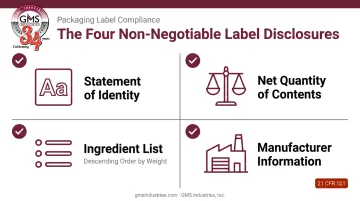
- The FDA requires four disclosures: identity statement, net quantity, ingredient list, and manufacturer info
- Nutrition Facts panels follow strict formatting, placement, and font-size rules with narrow exemptions
- FALCPA and the FASTER Act require all 9 major allergens identified via one of two approved methods
- Organic, non-GMO, and date labels follow separate voluntary rules, not safety disclosures
The Non-Negotiable Identity and Quantity Disclosures Every Label Needs
Four elements form the baseline of virtually every packaged food label sold in the United States. The FDA's Food Labeling Guide governs all of them, and skipping any one is a compliance failure regardless of how the rest of the package looks.
Statement of Identity
The product's common or usual name must appear in bold as the most prominent text on the Principal Display Panel (PDP), the panel a shopper sees first on the shelf.
Under 21 CFR 101.3, this name needs to be reasonably related in size to the rest of the PDP's printed matter and sit generally parallel to the base of the package.
Form descriptors matter here too. "Sliced peaches" and "diced tomatoes" aren't interchangeable with plain "peaches" or "tomatoes" if the product has been processed that way. The name has to describe what's actually inside.
Net Quantity of Contents
Net quantity (weight, volume, or count) has a specific home on the label: the bottom 30% of the PDP, generally parallel to the package base. That placement rule loosens only when the PDP is 5 square inches or smaller.
- Must appear as a distinct item, separate from other text
- U.S. customary units (ounces, pounds) are required under current federal rules
- Metric units may appear alongside them, though they aren't federally mandated on their own
Ingredient List and Manufacturer Information
Ingredients must appear in descending order by weight, using common names, not scientific or technical terminology. "Sugar," not "sucrose." Manufacturers can group ingredients present at 2% or less at the end, following language like "Contains 2 percent or less of."
The label also needs the name and address of the manufacturer, packer, or distributor. If the company listed didn't actually make the product, the label must say so with clarifying language such as "manufactured for" or "distributed by."
One formatting rule trips up a lot of package designs: no intervening graphics or unrelated text can appear between required disclosures. A logo, tagline, or seasonal graphic wedged between the ingredient list and the manufacturer's address violates this rule, no matter how minor the design element seems.
Nutrition Facts Panel: What Must Appear and Where
The Nutrition Facts panel lives on the information panel, typically the panel immediately to the right of the PDP, inside a box set off by hairlines. Small or oddly shaped packages may qualify for an alternate format.
Point size rules are specific: "Calories" must run at least 16-point bold type. The calorie number itself must be at least 22 point.
Required nutrients on the standard panel include:
- Calories, total fat, saturated fat, and trans fat
- Cholesterol and sodium
- Total carbohydrate, dietary fiber, total sugars, and added sugars
- Protein
- Vitamin D, calcium, iron, and potassium
Understanding %Daily Value
Percent Daily Value tells shoppers how a serving fits into a 2,000-calorie diet. Take sodium: the FDA's reference value is 2,300 mg per day. A serving with 850 mg of sodium works out to 850 ÷ 2,300 × 100 = roughly 37% DV.
The FDA's guide to reading the Nutrition Facts label walks through this math in more detail, useful for any label reviewer double-checking a printer's proof against the source nutrient data.
Who's Exempt
Not every packaged food needs a full panel. Exemptions apply to:
- Small businesses with no more than $500,000 in annual gross sales, or $50,000 in annual food sales, to consumers
- Low-volume products under 100,000 units sold annually by companies with fewer than 100 full-time employees (with an annual FDA notice filed)
- Raw produce and fish sold without nutrient claims
- Bulk food shipped solely for further manufacturing or repacking
Nutrient content claims like "low fat" or "high fiber" aren't free-form marketing language, either. "Low fat" caps out at 3 g of fat per reference serving; "high fiber" requires at least 20% DV, or roughly 5.6 g, per serving. The FDA controls exactly when these terms can legally appear.
Allergen Labeling: The Law Behind Clear Identification
The Food Allergen Labeling and Consumer Protection Act (FALCPA) of 2004 is the law requiring major allergens to be clearly identified on packaged food labels. It was expanded in 2021 by the FASTER Act, which added sesame as the ninth major allergen effective January 1, 2023.
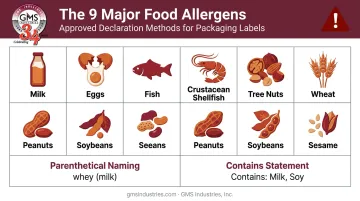
The nine major allergens are:
- Milk
- Eggs
- Fish
- Crustacean shellfish
- Tree nuts
- Wheat
- Peanuts
- Soybeans
- Sesame
At the time FALCPA passed, these allergen sources (minus sesame, added later) accounted for roughly 90% of serious food-allergic reactions in the U.S.
Two Approved Ways to Declare Allergens
Manufacturers have exactly two legally acceptable methods, and no third option:
- Parenthetical naming: identifying the source right in the ingredient list, such as "whey (milk)" or "lecithin (soy)"
- A "Contains" statement: placed immediately after the ingredient list, naming every major allergen present
Fish, shellfish, and tree nuts require species-level identification (think "shrimp" or "almonds," not just "shellfish" or "nuts"), because reactions can be species-specific.
Where Allergens Hide
Uncommon ingredient names create real risk. Casein, albumin, and lecithin don't obviously read as "milk," "egg," or "soy" to most consumers, which is exactly why the source-naming requirement exists.
Here's what's not required: "May contain" or "processed in a facility with" statements are voluntary cross-contamination disclosures, not legal mandates.
Yet the FDA identified undeclared allergens as the leading cause of Class I food recalls for at least three consecutive years. One retailer alone pulled more than 30 products in a single year for this exact failure.
Date Labels and Other Voluntary Claims to Get Right
Outside of infant formula, date labeling isn't federally required. Manufacturers add it voluntarily, but the terminology carries distinct meanings that consumers (and retailers) often misread:
- Best By / Best if Used By: peak quality or flavor, not a safety cutoff
- Sell-By: a retailer inventory cue, not a consumer safety date
- Use-By: the manufacturer's last recommended date for peak quality
- Freeze-By: when to freeze the product to preserve quality
Organic and Bioengineered Claims
USDA organic labeling comes in three tiers, each with a strict ingredient threshold:
| Claim | Minimum Organic Content |
|---|---|
| 100% Organic | All ingredients and processing aids |
| Organic | At least 95% (excluding water and salt) |
| Made with Organic [ingredient] | At least 70% (excluding water and salt) |
Bioengineered (BE) food disclosure has been mandatory since January 1, 2022, using text, the USDA BE symbol, or a digital link. Very small manufacturers under $2.5 million in annual receipts are exempt, as are certified organic products.
Claims like gluten-free, kosher, halal, and vegan aren't decorative, either: each requires accurate, substantiated backing before it goes on a package.
Why Label Precision Is a Packaging Priority, Not Just a Compliance Checkbox
A label can be flawlessly written and still fail in the real world. Three production errors turn compliant copy into a recall:
- The printed "Contains" statement shifts off-register
- A color mismatch obscures the ingredient panel
- A die-cut fold hides the net quantity declaration
Once any of these happens, the regulatory content on paper doesn't matter anymore. A peer-reviewed FDA recall analysis found that wrong package or wrong label issues accounted for roughly 26% of allergen recalls with a known root cause — production error, not writing error.
That's where packaging production becomes a compliance function.
GMS Industries has been producing folding cartons, pressure-sensitive labels, and printed instruction sheets for frozen food and CPG brands since 1989, working from facilities in El Paso, Texas and Mexicali, Mexico.
The company's prepress workflow, including ICC color profiling, Fuji Final Proof digital contract proofing, and GMG color-accurate proofing, is built to catch discrepancies before a job reaches the press. At that stage, a misregistered allergen statement is still just a file correction, not a recall.
Regulatory timing adds pressure. For manufacturers navigating a change like the sesame allergen requirement, GMS's pressure-sensitive label minimum order of just 1,000 units gives brands a fast, low-risk path to compliant labels (including as an oversticker on existing carton inventory) while larger carton runs catch up on the next production cycle.

Frequently Asked Questions
What are 5 things to look at on a food label?
Check the statement of identity, net quantity, ingredient list, allergen declarations, and the Nutrition Facts panel. These five elements cover the FDA's core mandatory disclosures on nearly every packaged food.
What are the labeling requirements for packaged processed foods?
Processed foods need a statement of identity, net quantity, ingredient list, manufacturer information, and a Nutrition Facts panel. Allergens must also be clearly disclosed per FALCPA using one of the two approved declaration methods.
What law requires that major allergens are clearly identified in labels on packaged foods?
The Food Allergen Labeling and Consumer Protection Act (FALCPA) of 2004 established this requirement. The FASTER Act expanded it in 2021, adding sesame as the ninth major allergen effective January 2023.
Is date labeling required by the FDA on packaged foods?
No, except for infant formula. Most date labels (Best By, Sell-By, Use-By) are added voluntarily by manufacturers for quality assurance, not federal safety mandates.
Do all packaged foods need a Nutrition Facts panel?
No. Exemptions exist for qualifying small businesses, low-volume products, raw produce without claims, and bulk foods shipped for further processing.
What happens if a food label doesn't meet FDA requirements?
Non-compliant labels can trigger product recalls, FDA warning letters, or retailer shelf removal. The FDA acts on complaints or inspections rather than pre-approving labels before they hit shelves.