Introduction
Picture a shopper grabbing a bag of frozen enchiladas. In three seconds, their eyes flick across a nutrition panel, a "keep frozen" date stamp, an allergen icon, and a bold logo. Each one is doing a different job, and most shoppers never notice.
For food brands, that stack of labels carries real risk. The FDA mandates several of these elements, and a mislabeled allergen can trigger a recall. Rising SKU counts, cold-chain packaging, and crowded shelves add further pressure to get the format right.
This guide breaks food packaging labels into two categories to help manage that risk: purpose-based (what the label communicates) and material-based (how it's physically constructed). Then we'll walk through a practical framework for choosing between them.
Key Takeaways
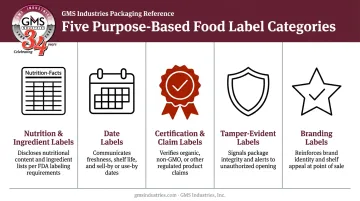
- Purpose-based labels cover nutrition, allergen, date, certification, tamper-evident, and branding needs
- Format-based labels include pressure-sensitive, shrink sleeve, in-mold, and wrap-around styles
- FDA and USDA regulate most required content, and undeclared allergens top recall causes
- Container shape, storage, and volume should drive format choice, not appearance alone
- The right partner balances compliance, durability, and shelf appeal across every format
What Is a Food Packaging Label and Why It Matters
A food label is any tag, mark, or printed matter attached to or printed on packaging that identifies, informs, or instructs the consumer. That's a broad definition, but it covers three distinct jobs:
- Identification - brand name, product name, and net quantity
- Information - ingredients, nutrition facts, allergens
- Instruction - storage conditions, prep steps, disposal guidance
Every packaged food product needs to nail all three, and it's not optional. Labeling has to satisfy compliance requirements before it does any design work. The FDA governs most packaged food labeling, while USDA oversees meat, poultry, and processed egg products.
Getting this wrong is expensive. Between 2004 and 2013, the USDA's Economic Research Service tracked 4,900 food-recall events in the U.S. Possible pathogen contamination caused 41% of them, but undeclared allergens caused 27% of recalls, and that share nearly doubled over the study period.
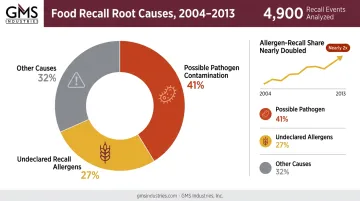
That growth shows label content itself, not just food safety practices, drives recall risk.
Types of Food Packaging Labels by Purpose
Beyond the familiar nutrition panel, several purpose-driven label types exist. Each answers a different regulatory or consumer question, and most packages combine more than one.
Nutrition & Ingredient Labels
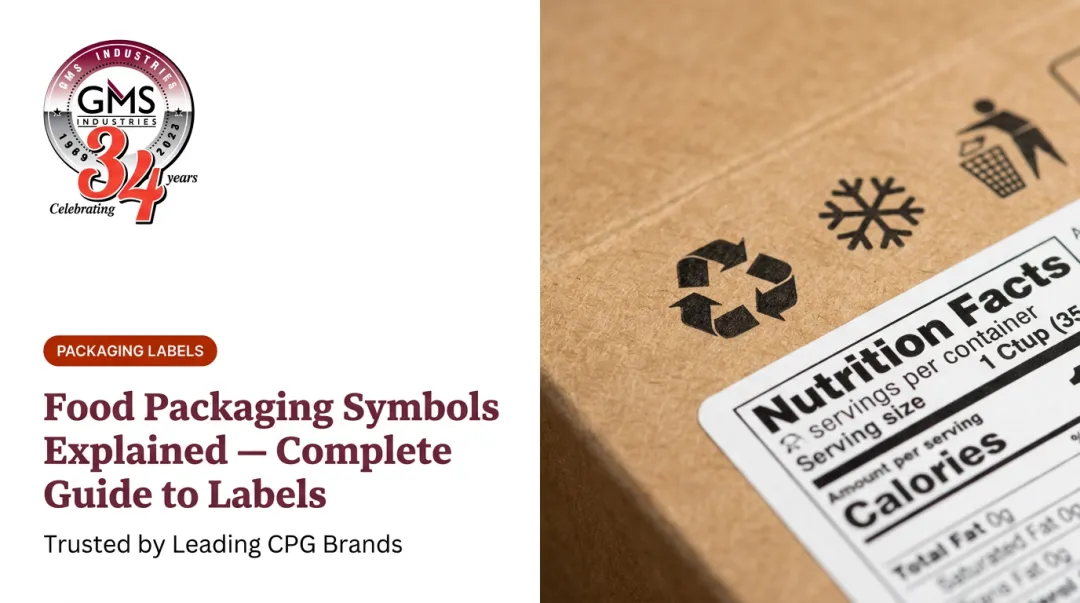
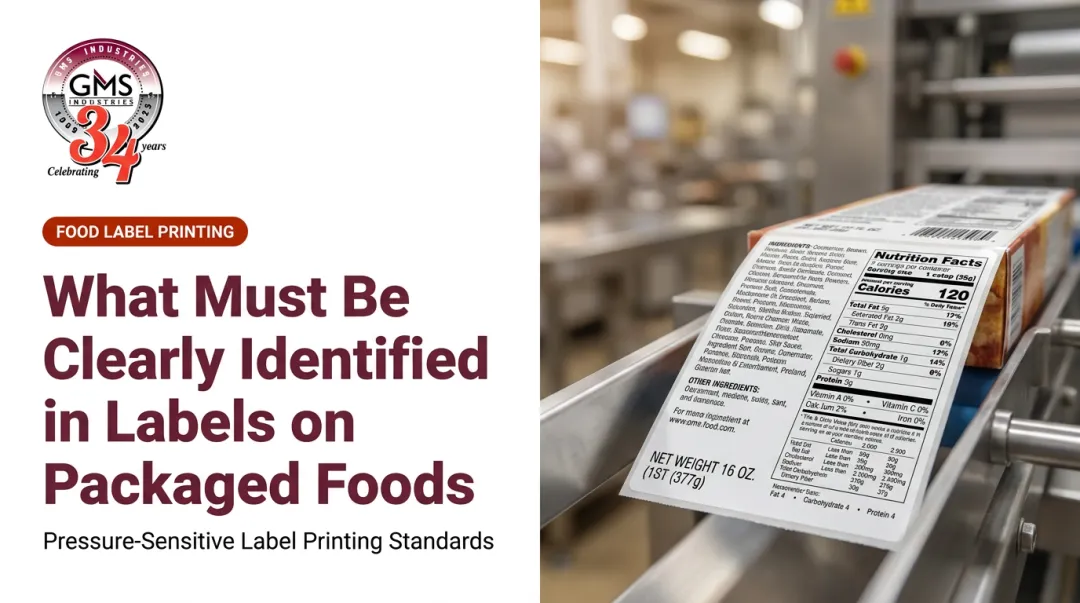
The Nutrition Facts panel lists calories, macronutrients, vitamins, and ingredients by weight, from most to least. Under 21 CFR 101.9, it must include serving size, servings per container, total fat, sodium, total sugars, added sugars, protein, and several vitamins and minerals.
Ingredients follow a strict rule too: they're listed in descending order of predominance by weight, using common names. This panel is mandatory on nearly all packaged foods and it's the single most-used tool shoppers rely on to compare products and spot allergens fast.
Date Labels (Best-By, Sell-By, Use-By, Freeze-By)
Here's something most consumers don't know: except for infant formula, date labels aren't federally mandated safety dates. They're manufacturer-driven quality indicators.
- Sell-By - an inventory management cue for retailers
- Best if Used By/Before - indicates peak quality, not safety
- Use-By - typically a quality date, except on infant formula where it's a federal requirement
- Freeze-By - suggests the optimal window to freeze a product while quality is still at its peak
That distinction matters more than it sounds. Consumer confusion between these date types drives a startling amount of waste. A ReFED analysis found that date-label confusion causes Americans to discard roughly 3 billion pounds of food worth $7 billion every year. Clear, consistent date labeling directly reduces this waste.
Certification & Claim Labels (Organic, Non-GMO, Geographical Indication)
These are regulated or third-party-verified marks confirming a specific production standard or regional origin. They're most common on premium and specialty products, and they can carry real pricing power. Non-GMO Project Verified marks confirm the absence of genetically modified ingredients, while geographical indication labels (such as Parmigiano Reggiano or Idaho potatoes) tie a product's identity to its region of origin.
USDA's Economic Research Service analyzed Nielsen Homescan data and found statistically significant organic price premiums across all 17 food products studied, ranging from 7% for spinach up to 82% for eggs. That's a wide range, and it confirms certification labels can drive meaningful margin gains beyond covering compliance costs.
Tamper-Evident Labels
These are seals or labels engineered to visibly show if a package has been opened or interfered with. FDA food security guidance recommends checking incoming packaging for compromised tamper-evident features, though this guidance is nonbinding rather than a blanket federal mandate.
You'll see these most often on:
- Ready-to-eat meals
- Takeout and delivery packaging
- Grocery items vulnerable to retail tampering
Customizable & Branding Labels
Branding labels communicate brand identity rather than regulatory compliance. Logos, slogans, QR codes, and promotional graphics all fall here. Virtually every product needs shelf differentiation, and branding elements typically layer alongside one of the compliance-focused label types above rather than replacing them.
Types of Food Packaging Labels by Material and Format
Once the required content is locked in, the next decision is physical construction. This affects durability, application speed, and how the product looks on shelf.
Pressure-Sensitive Labels
These are face stock, adhesive, and liner labels applied directly to bottles, jars, and tubs. They're the workhorse format for most food brands because they're versatile and fast to apply.
- Best suited for high-speed application on rigid containers
- Available in matte, gloss, and foil finishes
- Compatible with flexo, litho, and digital printing
GMS Industries produces pressure-sensitive labels this way, using flexographic presses like the Allied 300 Series and Mark Andy 830, along with litho and digital printing. The minimum order is just 1,000 labels, which makes this format the most accessible entry point for a brand testing a new SKU or launching regionally.
Guacamole tubs, pistachio pouches, and pico de gallo containers are real examples in GMS's own portfolio.
Shrink Sleeve Labels
A shrink sleeve is a polymer film that wraps fully around a container and is heat-shrunk to conform to its exact shape. It's the format of choice for contoured containers or refrigerated and frozen products that need full-body, high-impact graphics.
This is a core capability GMS Industries manufactures at its dedicated El Paso, TX facility, using ICC-profiled digital printing for precise, brand-accurate color matching. This level of control matters for brands whose packaging depends on consistent color across large print runs.
In-Mold Labels
In-mold labels get fused directly into the packaging wall during the molding process, becoming part of the container rather than a separate applied layer. They're best suited for rigid tubs and bottles, such as dairy or detergent containers, that need extra durability and a seamless finish.
Wrap-Around / Roll-Fed Labels
Printed on a continuous roll and wrapped around cylindrical containers, these labels typically cover the full circumference. They're built for cans and bottles that need 360-degree branding at high production speeds, and flexographic printing is the standard method for producing them.
Reseal & Dry-Peel Labels
These labels are engineered to peel back cleanly or reseal packaging after first use. Snack packs, lunch meats, wipes, and promotional peel-back offers all rely on this construction. It adds communication space without enlarging the package, though the added layers do increase construction complexity.
How to Choose the Right Type of Food Packaging Label
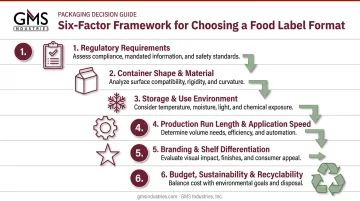
The "right" label type is dictated by regulatory needs, container shape, and go-to-market goals, not by trends on the shelf. Work through these factors in order:
- Regulatory requirements - specific to the product category, whether fresh, frozen, or supplement
- Container shape and material - rigid, flexible, contoured, or cylindrical
- Storage and use environment - including freezer resistance and refrigeration condensation
- Production run length and application speed - matched to volume and line speed
- Branding and shelf-differentiation goals - how the label needs to stand out on shelf
- Budget, sustainability, and recyclability requirements - cost and environmental targets
Cold-chain products deserve special attention here. UPM's technical guidance notes that minimum application temperature (how cold a surface can be when the label goes on) and service temperature (what it must withstand afterward) are two separate specifications, not interchangeable figures. Freezer-grade adhesives exist precisely because standard label stock fails in these conditions. GMS Industries applies these cold-chain specifications when working with frozen food and CPG clients before printing.
Common Mistakes to Avoid
- Overbuilding for volume - choosing shrink sleeves for a short run where pressure-sensitive labels would cost less per unit
- Ignoring cold-chain performance - picking a material that peels or smears in freezer or high-moisture conditions
- Compliance without shelf appeal, or the reverse - both need to work together, not compete
- Waiting too long to consult a packaging partner - regulatory and production issues are far cheaper to catch before a print run than after
Conclusion
Food packaging labels play two roles at once: meeting regulatory and informational requirements, and delivering on brand and format goals. Most products need to get both right simultaneously, and skipping either half creates risk.
Understanding these label types before you print prevents costly reprints and compliance headaches, while also protecting how the product performs on the shelf.
That's where a manufacturing partner matters. GMS Industries has spent over 30 years as a family-owned packaging partner producing compliant, custom labels, including shrink sleeves. The company also produces folding cartons and broader packaging solutions for frozen food, CPG, and specialty food brands.
If you're weighing formats for your next SKU, that's exactly the kind of decision worth a conversation before the print run, not after.
Frequently Asked Questions
What are the different types of food labels?
Food labels fall into two groups: purpose-based (nutrition, date, allergen, certification, tamper-evident, branding) and format-based (pressure-sensitive, shrink sleeve, in-mold, wrap-around). Most packages combine several of each.
What are the 12 food labeling requirements?
There's no single FDA list titled "12 requirements," but core mandatory elements include statement of identity, net quantity, ingredient list, allergen declarations, nutrition facts, and manufacturer information. Exact requirements vary by product category.
What's the difference between a primary and a secondary food label?
Primary labels carry brand, product, and nutrition information required for compliance. Secondary labels carry supplementary content like promotions, recipes, or QR codes, and they're typically optional.
Are food packaging labels legally required in the U.S.?
Yes, for most packaged foods, under FDA or USDA oversight depending on the product category. Limited exemptions exist for small businesses and certain raw products.
What's the difference between shrink sleeve and pressure-sensitive labels?
Shrink sleeves are heat-applied films that wrap 360 degrees around a container's exact shape, while pressure-sensitive labels are adhesive-backed and applied to a flat or curved surface. Sleeves suit contoured containers; pressure-sensitive suits speed and lower-volume runs.
How do I know which label material will hold up in cold storage or freezers?
Look for freezer-grade adhesives and films rated for your specific service temperature, not just application temperature. Pilot testing with your packaging partner, such as GMS Industries, before a full production run is the safest way to confirm performance.