Here's the tension: label space hasn't grown to match. Allergen disclosures, sourcing claims, traceability data, and sustainability certifications keep piling up, but your carton or label panel is the same size it was ten years ago.
QR codes have become the pressure valve. This guide breaks down the regulations shaping QR code use on food packaging, what you can link to, and how to design codes that scan reliably on a real production line, not just in a design mockup.
Key Takeaways
- QR codes help brands meet FDA and global disclosure rules without a full redesign
- Dynamic codes update instantly for recalls, ingredient changes, or new certifications
- Scan reliability depends on size, contrast, placement, and pre-production testing
- The right packaging partner adds QR codes without hurting die-cuts or shelf appeal
Why QR Codes Are Becoming Essential in Food Labeling
Food labeling rules keep expanding while the printable surface of a carton or label stays fixed. Regulators want more traceability, clearer allergen callouts, and verified sourcing claims, all within the same square inches brands have always had.
That squeeze is why QR codes now do double duty. A single scan can satisfy a legal disclosure requirement and serve up a recipe video or loyalty offer in the same interaction.
Consumer behavior backs this up. In the same 2025 GS1 US survey, 71% of shoppers said they're reading food labels more closely than they used to, driven largely by rising grocery prices and health concerns. That's a lot of attention landing on packaging with nowhere left to grow.
Static labels physically cannot keep up. You can shrink the font, but there's a floor: allergen warnings, nutrition panels, and country-of-origin statements all carry minimum type-size requirements. Once those fit, there's rarely room left for traceability detail, sourcing stories, or certification badges.
A QR code sidesteps the problem by moving that content off the substrate and onto a phone screen. At GMS Industries, this shift already shapes label and carton design for food and beverage clients: QR placement gets planned into the artwork at the prepress stage instead of squeezed in later.
FDA Food Traceability Rule (FSMA 204) and Critical Tracking Events
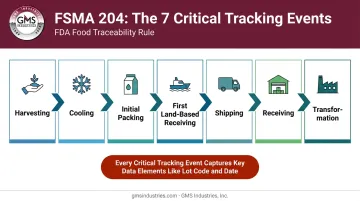
The clearest regulatory driver right now is the FDA's food traceability rule under FSMA 204. It applies to foods on the Food Traceability List, think leafy greens, deli salads, fresh-cut fruit, shell eggs, and soft cheeses, and requires tracking specific data at seven Critical Tracking Events:
- Harvesting
- Cooling
- Initial packing of a raw commodity
- First land-based receiving from a fishing vessel
- Shipping
- Receiving
- Transformation
Each event carries its own Key Data Elements, such as harvest date, traceability lot code, and cooling location. FDA doesn't mandate QR codes as the delivery method; a compliant traceability plan and recordkeeping system are the actual legal requirement.
A QR code that surfaces this data at the point of scan can still speed up recall response dramatically. A lot code that once took days to trace through the supply chain can now turn up in seconds.
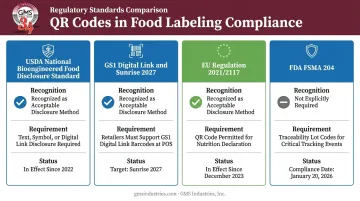
That speed matters because the compliance timeline itself keeps shifting. The rule's original compliance date was January 20, 2026. FDA has proposed pushing that to July 20, 2028, and Congress has directed the agency not to enforce it before then. That gives brands breathing room, but the direction is clear: traceability recordkeeping is only getting stricter.
Key Regulations Governing QR Codes on Food Packaging
No single law requires every food brand to print a QR code. But several existing and emerging standards specifically recognize QR codes as a compliant disclosure method, pushing them from a nice-to-have toward default practice.
National Bioengineered Food Disclosure Standard
This USDA rule permits four disclosure methods for bioengineered ingredients:
- On-package text disclosure
- The BE symbol
- A digital link, such as a QR code
- A text-message option
This flexibility lets brands add QR-based disclosure without redesigning their entire label footprint. If you choose the QR route, the code must sit next to wording like "Scan here for more food information," and the first screen a shopper lands on has to show the bioengineered disclosure, not a marketing page.
Brands using the digital-link method must also offer a phone number as a fallback for shoppers without a smartphone or reliable data plan.
GS1 Digital Link and Sunrise 2027
Retail is moving from 1D barcodes to 2D codes like QR under an industry initiative called Sunrise 2027. By the end of 2027, GS1 wants point-of-sale systems capable of reading 2D codes alongside existing linear barcodes, not replacing them outright.
A GS1 Digital Link QR code can encode a product's GTIN and link straight to traceability data, safety information, or consumer content in the same symbol that scans at checkout. For food brands, that means a single QR code could someday handle checkout scanning, recall lookups, and ingredient disclosure at once.
International Rules Trend the Same Direction
The EU isn't mandating QR codes broadly, but it's opening the door. Under Regulation (EU) 2021/2117, wine producers can now list ingredients and nutrition facts online instead of on-label, and the European Commission's implementation guidance names QR codes as an acceptable access method. Energy values and allergen information still have to stay on the physical label.
What Happens If You Ignore This
QR codes aren't mandatory across the board today. But treating digital disclosure as optional carries real risk:
- FDA can order mandatory recalls when a food is misbranded for undeclared allergens
- Warning letters, seizures, and delisting from major retailers are all on the table for non-compliant labeling
- In November 2024, Babcock Dairy recalled roughly 41 cases of ice cream after egg and Yellow 5 went undeclared on the label
Brands building QR-based disclosure into their packaging now are better positioned as rules tighten, instead of scrambling to retrofit compliance later.
What Information Can You Include in a Food QR Code?
A single QR code can carry far more than a static label ever could. Most food brands link to some combination of:
- Nutrition facts and serving details beyond what fits on the panel
- Allergen warnings, including cross-contact statements
- Ingredient sourcing, from farm origin to supplier certifications
- Sustainability practices, like packaging recyclability or sourcing claims
- Batch or lot codes for traceability and recall lookups
- Recycling and disposal instructions specific to the packaging material
Required disclosures vary by region and ingredient. A product sold in both the U.S. and the EU might need different bioengineered-ingredient language or nutrition formatting depending on the shelf it lands on.
This is where a dynamic QR code earns its value. Instead of running separate packaging for every market, one code can serve region-specific content based on the scanner's location or language, with no new print run required. GMS Industries prints these codes directly into flexo and litho label runs for food and beverage clients, so the code stays sharp and scannable even on foil-laminated stock.
Practical tip: don't overload the landing page. A scan should answer the shopper's question in two taps or less. Bury the allergen statement under a marketing carousel and you've defeated the purpose of adding the code at all.
Best Practices for QR Code Design & Placement on Food Packaging
A QR code that doesn't scan is worse than no code at all. It signals sloppiness right when you're trying to build trust. GS1's retail specification gives concrete sizing guidance:
| Spec | Requirement |
|---|---|
| Minimum module size | 0.396 mm (0.0150 in.) |
| Target module size | 0.495 mm (0.0195 in.) |
| Quiet zone | 4 modules on all sides |
| Symbology standard | ISO/IEC 18004 |
In practical terms, that's a printed code roughly 2x2 cm or larger, with clean blank space around it: no logos, text, or graphics crowding the edges.
Contrast and placement matter just as much as size:
- Use dark modules on a light background; it verifies better than the reverse
- Place codes on flat, non-creasing panels and avoid box corners, gussets, and foil substrates that distort the pattern under a scanner
- Keep the code within roughly 50 mm of any existing linear barcode if dual-marking, so checkout scanning isn't disrupted
Pair the code with a plain-language call to action. "Scan to see where this came from" performs better than a bare code with no context, since shoppers need a reason to pull out their phone.
Qualitative research from Progressive Grocer on grocery QR adoption backs this up: codes need a clear value exchange, not just a presence on the pack.
Dynamic codes are worth the small added cost. A static code is locked to whatever URL you encoded at print time. A dynamic code routes through a redirect instead, so you can update the destination content on the fly. Swap in a recall notice, a new certification badge, or corrected allergen information without reprinting a single carton.
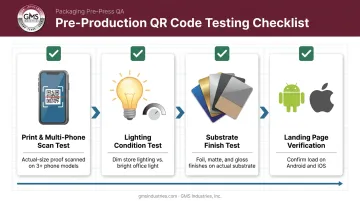
Before any run goes to full production, test the code:
- Print a proof at actual size and scan it with at least three different phone models
- Check scans under dim store lighting, not just bright office light
- Test on the actual substrate, since foil, matte, and gloss finishes all behave differently under a camera scanner
- Confirm the landing page loads correctly on both Android and iOS
Integrating QR Codes Without Compromising Label or Carton Quality
Adding a QR code isn't a prepress afterthought. It has to be planned alongside the structural design. On a shrink sleeve, the code needs a panel that won't warp or distort during shrinking. On a folding carton, it has to avoid die-cut lines, glue flaps, and score points where the pattern could crack or fold.
This is exactly the kind of detail that gets missed when QR placement is bolted on after artwork is finalized. GMS Industries manages prepress, diecutting, and print quality under one roof rather than coordinating across separate vendors, which makes it far easier to protect both scan reliability and shelf-ready branding.
Beyond Compliance: Business Benefits and Choosing the Right Packaging Partner
QR codes aren't just a compliance workaround. Used well, they support goals that reach past the regulatory checklist.
- Less printed waste. Moving sourcing information, recipes, or extended instructions off inserts and onto a digital page cuts down on printed collateral while keeping the same information depth.
- Trust through consistency. A code that's properly sized and reliably scannable tells shoppers you sweat the details. A pixelated code slapped on as an afterthought sends the opposite message.
- Scan data as a feedback loop. Dynamic QR platforms can show how many shoppers scan, when, and from where, giving brands visibility that static packaging never provided.
None of this works if the code fails at the point of scan, which is why packaging execution matters as much as the marketing strategy behind it.
GMS Industries has spent more than 30 years producing custom cartons, pressure-sensitive labels, and corrugated packaging for frozen food, CPG, and specialty food brands. That client list includes frozen meal lines like Tattooed Chef, where dietary disclosures such as gluten-free and vegan claims already have to fit cleanly on-pack alongside brand design.
That same discipline, balancing regulatory content, print quality, and shelf appeal, applies directly to adding a QR code without compromising the carton or label it sits on. Whether you're working with a 1,000-unit label run or a large-scale carton program, getting the placement, sizing, and production details right from the start avoids costly reprints later.
Frequently Asked Questions
What are QR codes used for on food packaging?
They give shoppers access to nutrition facts, allergen details, ingredient sourcing, and traceability data that won't fit on the printed label. Many brands also link to recipes or loyalty offers, turning a compliance tool into a marketing touchpoint too.
Are QR codes required by law for food labels?
Not universally. They're recognized as a valid compliance method under standards like the National Bioengineered Food Disclosure Standard, and adoption is expected to grow as traceability and disclosure rules expand.
Can small food businesses and local producers use QR codes effectively?
Yes. QR code generation is inexpensive, and pressure-sensitive labels can be ordered in runs as small as 1,000 units. That makes it realistic for small producers to add transparency features once limited to large brands.
What's the difference between static and dynamic QR codes for food labels?
Static codes point to one fixed URL forever. Dynamic codes route through a redirect, so you can update linked content, like a recall notice or new certification, without reprinting packaging.
How do I make sure my QR code scans properly on food packaging?
Keep the code at least 2x2 cm with strong contrast and a clean quiet zone on a flat, non-creasing surface. Test it across multiple phones, lighting conditions, and print substrates before full production.
Do QR codes help meet FDA food traceability requirements?
They can surface FSMA 204 data like harvest dates and lot codes at the point of scan, speeding up recall response. But the underlying recordkeeping and traceability plan, not the code itself, is what satisfies the legal requirement.