Companies invest significantly in product development, branding, and paid acquisition, then ship their products in boxes that do nothing once sealed. No message. No offer. No reason for the customer to come back. The unboxing moment — the peak of post-purchase excitement — passes without leaving any impression beyond the product itself.
Most brands focus their retention efforts on email sequences and retargeting ads. Both are valuable, but both reach customers when they're busy, distracted, or actively ignoring marketing messages. Package inserts work differently: they're encountered at exactly the moment a customer is most engaged with your brand.
This article covers what package inserts are, why they work, the specific business advantages they deliver, what brands lose by skipping them, and how to run an insert program that produces measurable results.
Key Takeaways
- Package inserts are printed materials or small items placed inside shipments — they reach customers during unboxing, when engagement is highest
- Distribution cost is zero — the shipping fee is already paid, so inserts ride along free
- Inserts drive emotional loyalty, repeat purchases, and cross-sell revenue, with results trackable via QR codes and promo codes
- Every unboxed shipment is a free marketing touchpoint — most brands never use it
- Effective programs pair intentional design with trackable mechanics (QR codes, unique promo codes)
What Are Package Inserts?
Package inserts are printed cards, notes, instruction sheets, product samples, or small branded items placed inside a shipment before it leaves the warehouse. They're not the outer packaging — they're what greets the customer when the box is opened.
They show up across e-commerce, direct-to-consumer, and retail fulfillment in categories ranging from cosmetics and food and beverage to home goods, hardware, and nutraceuticals. Any business shipping a physical product to an end customer has the infrastructure to use them.
Inserts are a communication channel. A thank-you card, a reorder reminder, a product sample, or an instruction sheet printed to brand standards each serves a defined purpose — keeping the brand present after the sale closes and prompting the customer's next move.
Key Advantages of Package Inserts
The advantages below are grounded in commercial outcomes — retention, marketing efficiency, and revenue — not abstract brand sentiment. Each works best when tied to a specific goal rather than used as a generic add-on.
Building Customer Loyalty Through Emotional Connection
A package insert creates a one-to-one moment with a customer that most digital channels can't replicate. A personalized thank-you note referencing the specific product purchased, or a small surprise gift tucked inside, shifts the experience from transactional to relational. That shift has measurable commercial consequences.
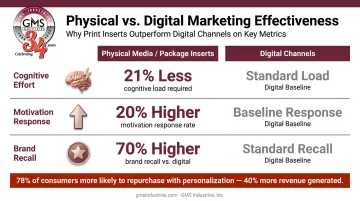
Unlike a post-purchase email filtered into a promotions tab, an insert is physically encountered during unboxing. Research from Canada Post and True Impact found that physical media requires 21% less cognitive effort to process than digital, generates a 20% higher motivation response, and produces 70% higher brand recall. Physical touchpoints are neurologically more effective at creating memory and motivation — not just harder to ignore.
The business case for emotional connection isn't soft. McKinsey's personalization research found that 78% of consumers are more likely to repurchase from brands that personalize, and companies excelling at personalization generate 40% more revenue from those activities. Personalized inserts are one of the most cost-accessible ways to deliver that experience at scale.
KPIs directly affected:
- Customer retention rate
- Repeat purchase rate
- Net Promoter Score (NPS)
- Social media mentions and user-generated content volume
When it matters most: Crowded categories where product differentiation is difficult — cosmetics, food and beverage, CPG — and early-stage brands where the first purchase needs to convert into a second.
Cost-Effective Marketing Within Existing Shipping Spend
Here's what sets inserts apart from every other marketing format: distribution is already paid for.
When a brand ships a product, the fulfillment cost is a fixed operational expense. An insert travels inside that shipment at no additional distribution cost — the only incremental spend is design and print. A discount card, referral offer, or product sample turns an existing cost into a revenue-generating touchpoint.
The audience is also pre-qualified. Inserts don't reach cold prospects who may or may not be interested — they reach proven buyers who already trusted the brand enough to purchase. Direct mail benchmarking from ANA's 2023 Response Rate Report showed 112% ROI for letter-sized direct mail, compared to 44% for email to house lists and 23% for prospect lists — and inserts have the additional advantage of arriving with an already-purchased product rather than unsolicited.
Basic tracking mechanics make insert programs measurable:
- Unique discount codes tie redemption directly to the insert
- QR codes linked to specific landing pages track scan rates and downstream behavior
- Referral codes measure new-customer acquisition generated by existing customers
KPIs directly affected:
- Cost per acquisition (repeat customers)
- Redemption rate on insert offers
- Marketing spend efficiency
- Customer acquisition cost reduction
When it matters most: Small-to-mid-size brands with tight marketing budgets, and high-volume fulfillment operations in frozen foods, CPG, and nutraceuticals where per-unit insert cost at scale becomes negligible.
Cross-Selling and Repeat Purchase Revenue
A customer who just opened a package is in a high-trust, high-intent state. They made a decision, acted on it, and received something they wanted. That's the optimal moment to introduce what to buy next.
Cross-sell inserts work across formats:
- A skincare brand includes a sample of a complementary serum alongside a moisturizer
- A CPG food company includes a recipe card featuring two products from the same line
- A nutraceutical brand times a reorder reminder insert to arrive as the product approaches depletion — no separate campaign required
A well-designed card with a clear recommendation and a time-limited incentive is enough to redirect attention to the next order.
KPIs directly affected:
- Average order value (AOV) over customer lifetime
- Cross-category purchase rate
- Reorder rate
- Sample-to-purchase conversion rate
When it matters most: Brands with multiple SKUs or product lines — frozen food manufacturers, cosmetic companies with complementary categories, hardware brands upselling accessories — have immediate cross-sell opportunities inside every box they ship.
What Happens When Package Inserts Are Missing
Brands that skip inserts leave a direct marketing channel empty — one their competitors are already using.
The immediate result: a customer receives their order, feels no emotional pull beyond the product itself, and defaults to price or convenience the next time they shop. That's rational behavior — they were never given a reason to choose differently.
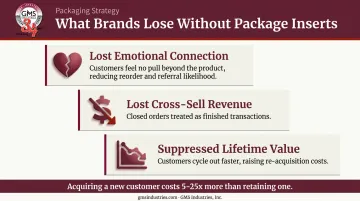
What compounds over time is where the real damage accumulates. According to HBR, acquiring a new customer costs 5 to 25 times more than retaining an existing one, and increasing retention by just 5% can raise profits by 25% to 95%. Brands that rely entirely on acquisition to grow are operating on the expensive side of that equation — and insert programs are one of the lowest-cost tools available to shift the balance.
Three specific losses compound over time:
- Lost emotional connection — each order feels transactional, reducing the likelihood of reorder or referral
- Lost cross-sell revenue — every closed order is treated as a finished transaction rather than the start of the next one
- Suppressed lifetime value — without any mechanism to deepen the relationship, customers cycle out faster and cost more to re-acquire
None of these losses show up as a line item, which is exactly why they go unaddressed. By the time a brand notices the gap, a competitor has already used inserts to close it.
How to Get the Most Value from Package Inserts
Insert programs that work are intentional, consistent, and measurable. A generic card tossed in as an afterthought delivers generic results.
One Insert, One Goal
Each insert should accomplish a single thing: prompt a review, drive a reorder, introduce a product, or express appreciation. Multiple competing calls to action dilute all of them.
Match the goal to the customer's stage. First-time buyers respond to welcome messages and onboarding guidance; repeat customers respond better to loyalty rewards and cross-sell offers.
Design Quality Signals Brand Quality
A poorly printed insert undermines the brand signal it's supposed to reinforce. Paper weight, print clarity, and color consistency all communicate something before the customer reads a single word.
That's why insert production deserves the same care as the outer packaging. GMS Industries produces custom printed inserts with full color management — including ICC profiling and GMG workflow — so inserts can be matched to the same color standards as a brand's folding cartons and labels.
Make Every Insert Trackable
Unique promo codes, QR codes linked to specific landing pages, and referral codes turn an insert campaign into accountable marketing. Without tracking, there's no way to measure lift, optimize the offer, or justify continued investment.
This is also what separates a one-time insert from a real program.
Rotate for Relevance
Seasonal variations, new product tie-ins, and lifecycle-timed reorder nudges keep insert content from going stale. A nutraceutical brand, for example, might time a reorder reminder to coincide with the product's typical usage cycle — reaching customers exactly when they're most likely to reorder, rather than during a separate email push.
Conclusion
Package inserts work because they combine timing, personalization, and cost efficiency in a way no purely digital channel can. They reach customers at peak excitement, carry a message that costs a fraction of digital alternatives to deliver, and leave a physical impression that outlasts a scroll.
The advantages compound. A well-run insert program doesn't influence a single purchase — it builds the emotional habit and purchasing pattern that converts first-time buyers into long-term advocates, raising lifetime value with each shipment.
Treat inserts as an ongoing practice: test different goals, track redemption, refine the design, and align content with each stage of the customer lifecycle. The brands that do this consistently aren't just filling boxes — they're building relationships that hold through price increases, new competitors, and shifting markets.
GMS Industries has manufactured printed inserts, instruction sheets, and folding cartons for CPG, food, and hardware brands for over 36 years. If your packaging system isn't working as hard as it could, that's a straightforward problem to fix.
Frequently Asked Questions
What are the benefits of customer loyalty programs?
Loyalty programs increase repeat purchase rates, reduce customer acquisition costs, and raise lifetime value by giving customers structured reasons to return. Top-performing programs can lift revenue from redeeming customers by 15–25% annually — making the post-purchase moment, including the unboxing experience, a high-value place to introduce them.
What are the 4 C's of customer loyalty?
The 4 C's — Captive, Contented, Convenience-Seeker, and Committed — describe a spectrum of loyalty depth from reluctant retention to genuine advocacy. Package inserts help move customers along that spectrum by consistently demonstrating care and quality, reinforcing trust at every order.
What are the 3 R's of customer loyalty?
The 3 R's — Rewards, Recognition, and Relevance — are a practitioner framework for structuring loyalty initiatives. Inserts support all three: discount codes reward customers, personalized notes recognize them, and product recommendations tailored to their purchase history demonstrate relevance.
What types of package inserts are most effective for building customer loyalty?
Personalized thank-you notes, exclusive discount codes, and product samples tend to generate the strongest response. Print quality matters just as much as content — a well-finished insert signals that it belongs there; a flimsy card signals that it doesn't.
How do you measure the success of a package insert campaign?
Track unique promo codes, QR code scan rates, and repeat purchase behavior. The clearest measurement approach compares customers who received an insert against a control group who did not — the difference in reorder rate and average order value reflects the insert's actual lift.
How are package inserts different from other marketing channels?
Inserts reach proven buyers at the moment of highest engagement — unboxing — rather than targeting cold audiences through paid ads or competing for attention in a crowded inbox. They also carry no incremental distribution cost, since they ship inside boxes that are already going out.