Introduction
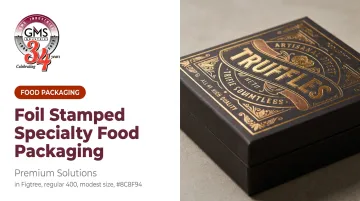
Walk down any gourmet grocery aisle and you'll notice something: your eyes don't drift evenly across the shelf. They snag on a flash of gold, a shimmer of silver, the iridescent catch of a holographic carton edge. That's foil stamping doing exactly what it's designed to do.
According to NielsenIQ, shoppers spend just 13 seconds evaluating a product before deciding. For specialty food brands competing against dozens of alternatives, that's a brutally narrow window. Packaging isn't just a container — it's the first sales pitch.
Foil stamping is one of the most reliable ways to win that 13-second moment. A reflective, tactile metallic finish on a folding carton or chipboard box signals quality before a consumer reads a single word.
This article covers what foil stamping is, how the process works on food packaging, which foil types suit which food categories, and how to use it strategically — without blowing your per-unit cost targets.
Key Takeaways
- Foil stamping transfers metallic or pigmented foil onto packaging surfaces using heat, pressure, and a metal die
- It communicates premium quality at the shelf, supporting higher price points for specialty food products
- Metallic, holographic, pigment, and textured foil types each suit different food categories and brand aesthetics
- Cost scales with design complexity, foil coverage, and production volume; larger runs reduce per-unit cost
- Pairing foil stamping with embossing or spot UV creates a multi-sensory effect ideal for gourmet and gift food products
What Is Foil Stamping for Specialty Food Packaging?
Foil stamping — also called hot stamping — is a specialty printing process that transfers a thin foil layer onto a packaging substrate using heat, pressure, and an engraved metal die. The result is a reflective, often raised finish that printed ink simply cannot replicate.
Unlike ink, foil doesn't absorb into the substrate or fade over a product's shelf life, holds up across distribution channels, and reads clearly even against dark or richly colored backgrounds — exactly the kind of dramatic backgrounds common in premium food packaging.
Where It Fits in Food Packaging
Specialty food packaging relies heavily on foil stamping across formats including:
- Folding cartons for gourmet chocolate, artisan confectionery, and premium snack brands
- Chipboard rigid boxes — high-end gift food sets and specialty frozen food packaging
- Setup boxes for premium tea, coffee, and spirits-paired gourmet gift sets
Packaging Strategies confirms that hot foil stamping applies to substrates including carton board and laminated board — the same materials used across most specialty food carton formats.
Foil Stamping vs. Foil Lining
Foil lining is a functional food-preservation layer inside packaging — it creates a barrier against moisture, oxygen, and light. Foil stamping is a decorative finishing technique applied to the outside of a carton for visual impact and branding. Both can appear on the same package, serving entirely different purposes.
How Foil Stamping Works on Food Packaging
The quality of a foil stamp comes down to three variables: die precision, foil selection, and process control. Get any one wrong, and the result shows up as soft edges, inconsistent coverage, or adhesion failures across a production run.
Step 1: Design and Die Creation
The desired artwork — a logo, brand wordmark, border, or pattern — is etched into a metal die. Each distinct foil color or layer requires its own die. Die precision directly determines the sharpness of the final imprint on the carton, which is why vector artwork matters here.
Step 2: Foil Selection and Setup
A roll of specialty foil film is threaded between the heated die and the packaging substrate. The foil film itself has three distinct layers:
- A decorative finish layer on top (metallic, holographic, pigment, or matte)
- A color carrier middle layer
- A heat-activated adhesive bottom layer
Step 3: Heat and Pressure Transfer
The die is heated to activate the adhesive layer, and controlled pressure bonds the foil to the substrate in precisely the etched design pattern. Excess foil is removed, leaving a clean imprint. Multiple colors or effects require separate passes through the machine.
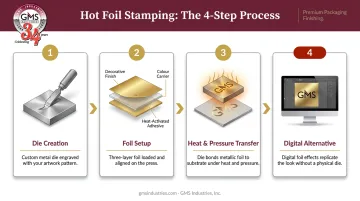
As KURZ notes, hot stamping requires perfectly coordinated temperature and pressure — making process control critical for consistent results across a production run.
Step 4: Digital Foil Stamping (Modern Alternative)
Where traditional hot stamping depends on a physical die, digital foiling uses specialty inks applied without one — making it far more flexible for certain scenarios:
- Short production runs
- Frequent design changes
- Prototype and test packaging for new food product launches
That flexibility comes at a cost for volume. PostPress Magazine notes that toner-based digital foiling requires multiple processing steps, making it impractical for high-volume runs. For consistent, high-quantity production, traditional hot stamping is the more reliable choice.
A Note on Food Safety
Foil stamping is applied to the exterior surface of sealed packaging — not in direct contact with food. That said, food brands should confirm with their packaging supplier that all adhesives and foil materials comply with applicable regulations.
In the US, relevant FDA guidance covers adhesives under 21 CFR Part 175 and paper/paperboard components under 21 CFR Part 176. EU brands should verify compliance with EU Regulation (EC) No 1935/2004. Compliance is packaging-structure and supplier-specific — don't assume automatic clearance.
Types of Foil for Specialty Food Packaging
Not all foils serve the same purpose. Choosing the right type depends on the food category, the brand aesthetic, and the retail environment.
Metallic Foil (Gold, Silver, Copper, Bronze)
The workhorse of premium food packaging. Crown Roll Leaf confirms that metallic foils offer the most reflective finish achievable — one that other printing methods can't match.
- Gold — directly associated with high quality and high price by premium chocolate consumers, per a 2020 peer-reviewed study. The go-to choice for confectionery and chocolate packaging
- Silver — a strong fit for modern artisan brands, savory specialties, coffee/tea, and premium snack packaging
- Copper/bronze — favored by craft food brands that want warmth and texture over traditional metallic polish
Holographic Foil
Produces an iridescent, rainbow-shifting effect that captures attention from multiple angles, making it particularly effective for:
- Limited-edition seasonal packaging (holiday confections, gift sets)
- Food brands targeting trend-forward, younger consumers
- Promotional runs where shelf standout is the primary objective
Pigment Foil (Matte or Gloss)
Available in virtually any color without metallic shine. Matte pigment foils (borrowed from high-end wine and spirits labels) suit specialty food packaging where subtlety outperforms flash. They're the right call for organic, natural, and artisan brands where a refined aesthetic reinforces the product story.
Textured and Effects Foils
Simulate finishes like brushed metal, leather grain, or patterned sparkle. Best suited for:
- Gourmet food gift packaging
- Specialty frozen food cartons where tactile shelf differentiation encourages first-time purchases
Quick-Reference: Foil Type by Food Category
| Food Category | Recommended Foil |
|---|---|
| Premium chocolates & confections | Gold metallic |
| Seasonal / limited-edition products | Holographic |
| Organic / natural specialty foods | Matte pigment |
| Artisan savory, coffee/tea, premium snacks | Silver metallic |
| High-end gift food sets | Textured / effects |
Why Specialty Food Brands Choose Foil Stamping
Elevated Perceived Value
Metallic finishes communicate premium quality before a product is tasted, touched, or opened. The gold-quality association documented in premium chocolate consumer research isn't category-specific; it transfers across gourmet food segments. For food brands that compete on quality positioning rather than price, foil stamping is one of the fastest ways to establish that positioning visually.
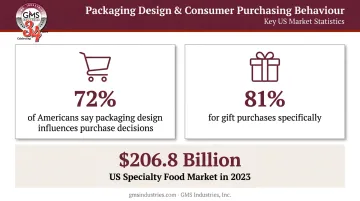
Ipsos research found that 72% of Americans say packaging design often influences their purchase decisions — a figure that climbs to 81% for gift purchases. For specialty food brands that depend on gifting occasions (holidays, corporate gifts, seasonal celebrations), that 9-point difference is worth building strategy around.
Shelf Differentiation
The specialty food market reached $206.8 billion in US sales in 2023, with conventional retail accounting for 67% of that market share (Specialty Food Association, 2024). That's a crowded, competitive shelf environment. Foil's reflective quality catches the eye even in lower-lighting retail conditions — a physical property that matte or digitally printed cartons simply don't share.
Brand Storytelling at Every Touchpoint
Foil stamping applied to logos, borders, and brand typography reinforces premium positioning from shelf to unboxing. For brands sold through e-commerce or gifted directly, the unboxing moment carries the same weight as the shelf impression. Foil-stamped cartons deliver that premium signal across both touchpoints without adjustment.
Finish Longevity
Unlike ink-based printing, foil doesn't fade, scratch, or degrade across a product's shelf life. For specialty foods sold through multiple distribution channels — retail, e-commerce, wholesale, or farmers' markets — that durability matters. The finish that ships from the warehouse looks the same when it reaches the consumer.
For food CPG brands managing multi-channel distribution, that consistency is a production requirement, not a nice-to-have. GMS Industries has produced custom folding cartons and chipboard boxes for frozen food and F&B clients for over 36 years, with the Bobst diecutting and finishing equipment to maintain foil quality at volume.
Design Tips for Foil-Stamped Specialty Food Packaging
Simplify Your Artwork for Foil
Foil stamping performs best with clean, bold vector artwork. Fine details and hairline elements can lose definition during transfer. Practical design rules:
- Use a minimum 8pt font size for stamped text
- Keep shapes well-defined with solid edges
- Avoid repurposing standard print files — adapt artwork specifically for foil application
- Bold brand elements (logos, wordmarks, key borders) rather than attempting intricate patterns
Combine with Complementary Finishing Techniques
Foil on its own commands attention. Paired with embossing or spot UV, it becomes a tactile and visual experience that's hard to replicate — and much harder for a competitor's product to match on shelf.
The combinations that work best for premium food packaging:
- Foil + embossing — raises the foil element in 3D, adding tactile dimension to gourmet gift boxes and confectionery cartons
- Foil + spot UV — creates gloss-versus-matte contrast that makes the metallic element pop against a matte field
- Foil + debossing — recesses the stamped area for a refined, restrained look suited to premium natural food brands
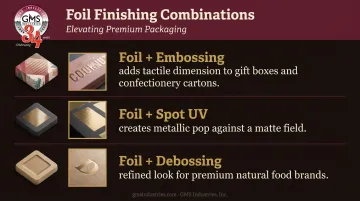
Plan these combinations from the design stage. Adding them as afterthoughts typically creates alignment issues and increases cost.
Choose Substrate and Background Color Strategically
Foil stamping adheres best to smooth, coated paperboard substrates. Gold and holographic foils are especially striking against dark, jewel-toned backgrounds — the deep navy, forest green, and burgundy palettes common in premium food categories.
Always request physical prototypes before committing to a full production run. Adhesion quality and visual effect can vary by substrate, foil type, and surface coating, and a prototype catches those variables before they become production problems.
Cost Considerations: Is Foil Stamping Worth It?
What Drives the Cost
Foil stamping costs are not one-size-fits-all. The main variables:
- Die creation — a one-time tooling cost per design; each foil color or layer requires a separate die
- Coverage area — larger stamped areas cost more than targeted accents like a logo or border
- Number of passes — multiple foil colors or effects require multiple machine passes
- Production volume — die costs are fixed, so higher volumes spread that cost across more units and reduce the per-unit impact significantly
Digital foil stamping eliminates die fees entirely, making it a practical entry point for specialty food startups, limited-edition runs, or brands testing a new packaging design before committing to full-volume production.
The ROI Framing
The more useful question is what foil stamping enables, not what it costs. Foil-stamped packaging supports higher retail price points, improves sell-through in premium food retail environments, and reduces dependence on promotional discounting. For specialty food brands competing on quality, packaging that signals that quality on the shelf is a direct revenue lever — not just a design choice.
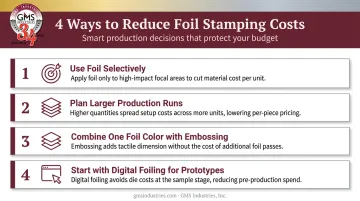
How to Minimize Cost Without Sacrificing Impact
- Use foil selectively — a foil-stamped logo or single border accent delivers strong visual impact at a fraction of the cost of full coverage
- Plan for larger runs to spread die creation costs across more units
- Combine one foil color with embossing rather than multiple foil passes — often more cost-effective with comparable or superior visual results
- Start with digital foiling for short runs and prototype approval, then transition to traditional hot stamping for full production
Frequently Asked Questions
How much does foil stamping cost for specialty food packaging?
Cost varies based on die creation fees (a one-time charge per design), foil coverage area, number of foil colors, and production volume. Digital foiling offers a lower-cost entry point for short runs by eliminating die fees, while traditional hot stamping becomes more economical at higher volumes as fixed die costs spread across a larger print run.
How does foil stamping work on specialty food packaging?
A heated metal die presses a three-layer foil film — with a heat-activated adhesive layer — onto the exterior surface of a food carton or box, bonding the foil to the substrate in precisely the etched design pattern. The result is a sharp, clean metallic or decorative imprint that won't fade or scratch.
What effect does foil stamping have on specialty food packaging?
Foil stamping creates a reflective, eye-catching finish that reads as premium across virtually every food category. Paired with embossing, it adds a tactile dimension that reinforces that signal — and consumers register both quality and elevated price before the product is even opened.
What types of food packaging work best with foil stamping?
Smooth, coated paperboard folding cartons and chipboard rigid boxes are the ideal substrates — the formats commonly used for gourmet chocolate boxes, artisan confectionery, premium snack cartons, and specialty frozen food packaging. Rough or uncoated substrates can compromise adhesion quality.
Can foil stamping be combined with other finishes on food packaging?
Yes. Foil stamping pairs effectively with embossing (for 3D raised texture), debossing, and spot UV coating. Planning these combinations from the design stage — rather than treating them as add-ons — produces the best structural and visual results.
Is foil stamping food-safe for use on food packaging?
Foil stamping is applied to the exterior surface of sealed packaging, not in direct food contact. Food brands should still confirm with their packaging supplier that all adhesives and foil materials comply with applicable regulations — including FDA 21 CFR guidelines in the US or EU Regulation (EC) No 1935/2004 in Europe — as compliance is packaging-structure specific, not automatic.